
B2C lead generation is the work of collecting contact details from individual consumers — people who decide for themselves, quickly, and often on impulse. The mechanics are the ones set out in B2B lead generation, with every proportion reversed: volume in place of depth, hours in place of months, one person in place of a buying committee. This page is the opposite pole of that hub, and reading the two together is the fastest way to see why a habit carried from one model breaks the other.
What is B2C lead generation?
B2C lead generation turns anonymous audiences — site visitors, followers, ad viewers — into named contacts: a newsletter sign-up, a quote request, an interest form. The lead statuses behave as they do everywhere, marketing-qualified before sales-qualified, but the thresholds sit lower and closer together, because a consumer can travel from first contact to purchase inside a single day and the process has to keep up.
The economics rest on volume. A single consumer lead is worth less than a business lead, and there are many times more of them, so the result is decided by how efficiently a large number of contacts is handled rather than by how carefully each one is cultivated.
How does B2C lead generation differ from B2B?
Six differences set the whole strategy, and each one has a direct operational consequence.
| criterion | B2C | B2B |
|---|---|---|
| Who decides | one person, the consumer | a buying committee |
| Decision cycle | hours to days | weeks to months |
| What drives the decision | emotion, impulse, an offer | logic, return on investment, risk reduction |
| Economics | many leads of low value | few leads of high value |
| Main channels | social platforms, search, email | professional networks, search, expert content |
| Cost per lead | an order of magnitude lower | an order of magnitude higher |
The practical conclusion is that moving habits between the models damages both directions: a ten-field form destroys a consumer conversion rate, and an impulse campaign will never sell a six-figure implementation.
Which channels generate B2C leads?
Four channels carry most of the volume in consumer markets.
Social platforms with native forms
Lead ads collect contact details without the user leaving the app: minimal friction, high volume, and a hard requirement to respond quickly, because a contact collected in two taps is also given away in two taps.
Search visibility on consumer queries
The questions and comparisons people type before buying. This is organic traffic with high intent and the lowest cost over a long horizon; how the same channel behaves in a business market is covered in our guide to SEO leads.
Paid search
Reaching somebody at the moment they are actively looking for a product or a service, which in consumer markets is strongest for local demand and for services needed immediately.
Email to an owned list
Newsletters and sequences sent to contacts already collected — the cheapest route back to somebody who has already met the brand.
Third-party leads also exist as a market: call centres and ready-made databases. That route carries two live risks together, since quality varies unpredictably and processing personal data without a valid consent is a legal exposure that sits with the sender.
What makes a B2C strategy work?
A consumer strategy rests on four principles, and all four are about removing time and friction.
Simplicity at the point of conversion
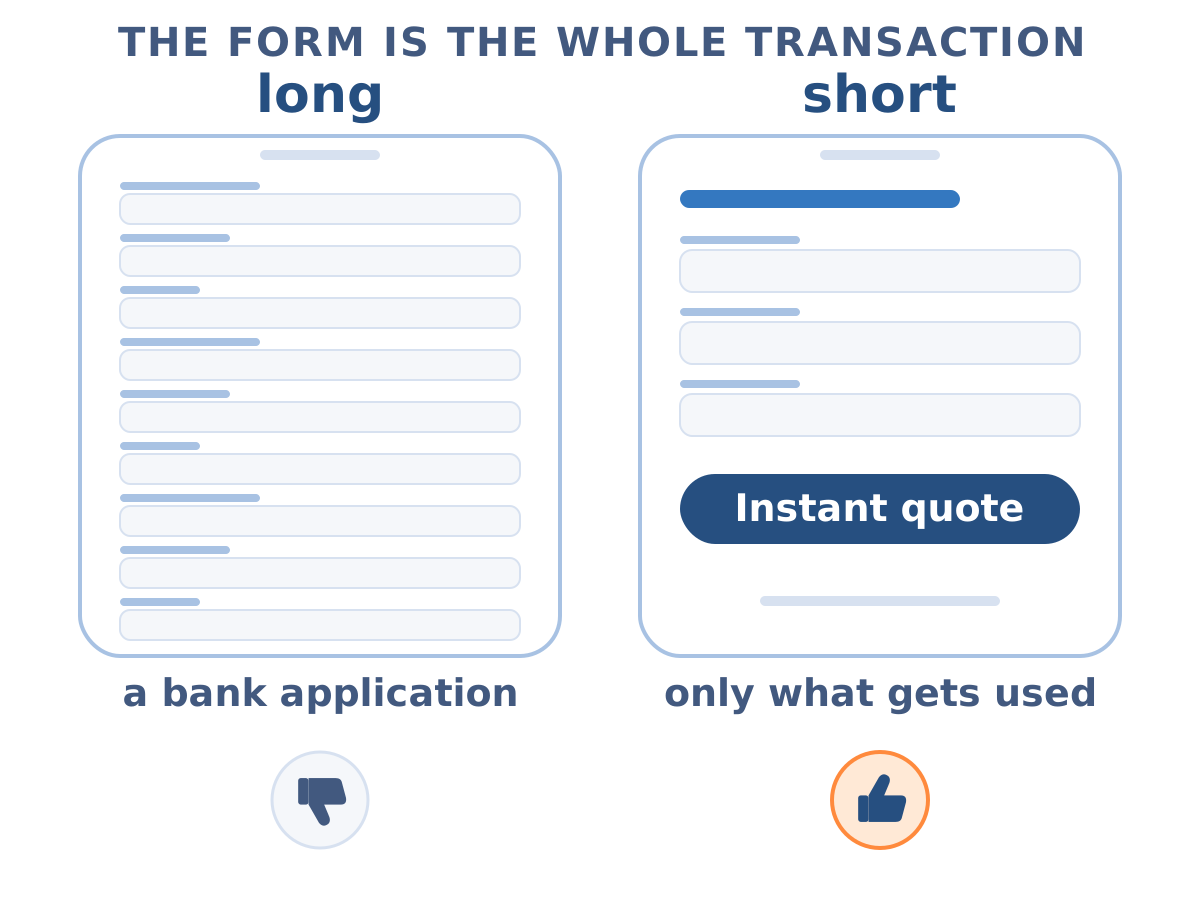
Only the fields that will actually be used belong on the form. The construction of that page is covered in the conversion guide.
Mobile first
Most consumer traffic arrives on a phone, so a page that is slow on a phone is a page that exists for very few people.
Value delivered immediately
A quote on the spot, a discount for signing up, the output of a calculator. A consumer exchanges contact details for a benefit now, and the exchange rate falls sharply for a benefit promised later.
Speed of response
A consumer lead cools within hours, and whoever calls first sells. Remarketing then picks up the people who left without converting the first time.
Can one company run both B2B and B2C lead generation?
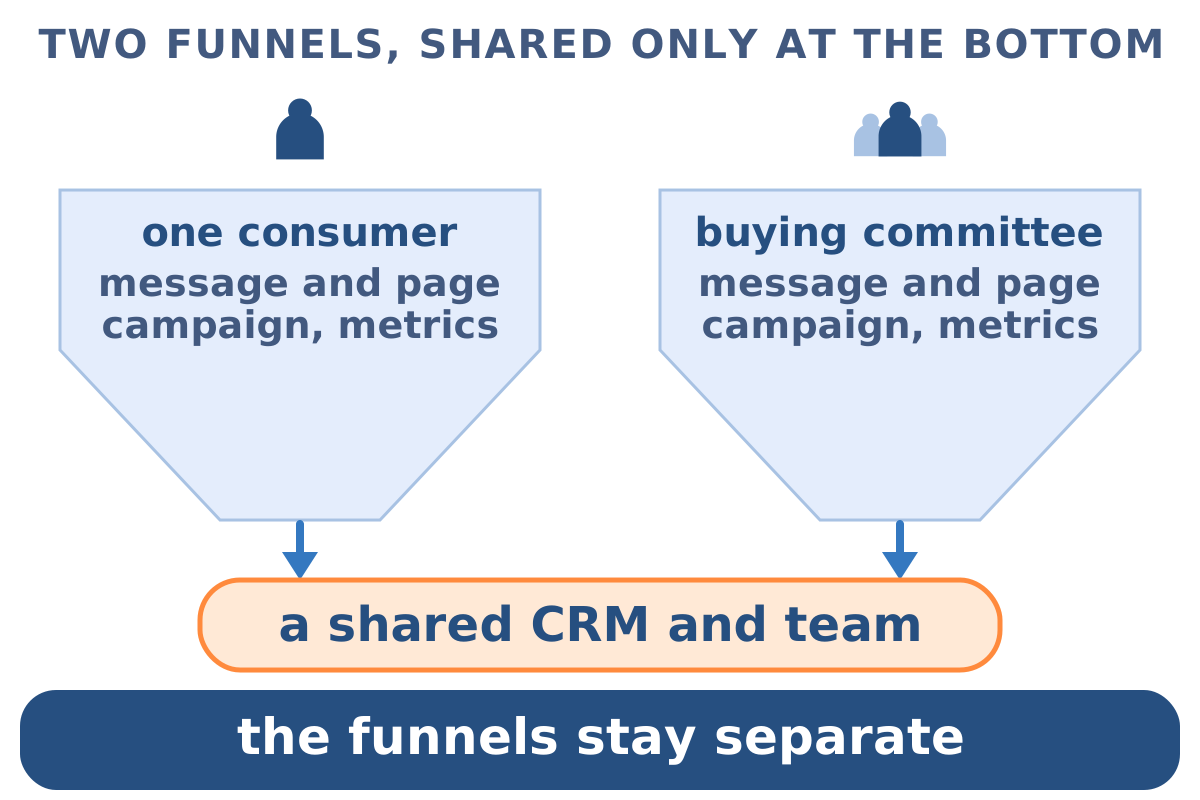
Yes, and several industries have to: a developer sells flats to consumers and whole floors to funds, a solar installer serves households and industrial sites, an insurer covers individuals and fleets. A message pitched halfway between a consumer impulse and a buying committee lands with neither. What stays shared is the CRM and the team that knows which process handles which enquiry. Keeping those records in order is the subject of our lead management guide.
What types of B2C leads are there?
The temperature classification works as it does in business markets, only faster. A hot lead — a price question, a request to be called — needs a response in minutes to hours. A warm lead, someone who signed up or started following, gets a welcome sequence. A cold lead, an old contact with no recent activity, gets occasional communication. The thresholds are shorter throughout: a consumer who has stayed quiet for a week has usually bought somewhere else.
How does data protection law affect B2C lead generation?
More heavily than in business markets, because every consumer lead is personal data. The foundation is consent: a separate marketing consent, a clear statement of who is collecting the data and why, and an easy way to withdraw. Purchased databases carry the largest exposure, since the liability for a missing consent attaches to whoever sends the message. A list built with consent grows more slowly and becomes an asset.
How is B2C lead generation measured?
Three indicators carry it: cost per lead by channel, lead-to-customer conversion, and return on advertising spend for paid campaigns. In consumer markets the numbers are large and arrive quickly, so optimisation runs weekly rather than quarterly — a weak channel shows itself after a few hundred leads rather than after a handful. Which indicators to define and how is set out in the lead generation metrics guide.
What are the most common mistakes in B2C lead generation?
Four mistakes account for most of the damage. A form built like a bank application, where every extra field removes a slice of the conversion rate. Slow handling, where a consumer enquiry left overnight is already dead. A page that fails on a phone. And measuring cost per lead alone without lead-to-customer conversion, which is how the cheapest leads turn out to be the most expensive ones.
FAQ
What does a B2C lead cost?
Less than a business lead by roughly an order of magnitude, with the exact position inside that band set by industry, channel and competition — highest in finance, property and medical services. The way the figure is built, channel by channel, is set out in the cost-per-lead breakdown.
Is it worth buying ready-made B2C lead lists?
It is a shortcut that usually costs more than it delivers: the quality of purchased contacts varies unpredictably, the conversion rate is low, and the legal exposure from missing consents is real. Volume arrives faster and more safely through lead ads and paid search run on your own consent collection.