
Lead generation is the process of turning demand into contact details: a person or a company shows interest in a product or service and leaves a way to be reached. Everything that follows — qualification, nurturing, conversion, management — works on that record.
This guide covers what a B2B lead is, which channels produce them, the steps of the process, the types of lead a pipeline holds, what a lead costs and how quality is raised without cutting volume. drySEO has run these methods on its own B2B account since 2013 and publishes what the measurement returns. The work behind them is described in our SEO and SEM services. How a buyer travels from a search query to an order in the CRM is the shorter account of the same work, with the lab figures that back it.
What is B2B lead generation?
B2B lead generation is the process of identifying companies that need what you sell and obtaining a way to contact the person who decides. The unit of the process is the lead: a record holding contact details plus evidence of interest.
Three things separate it from consumer lead generation. The buyer is a committee rather than a person, so the content has to satisfy several roles with different questions — the engineer who checks whether it works, the manager who checks whether it fits the process, the finance role who checks what it costs to own. The cycle runs in months rather than minutes, so a lead has to be held through a long stretch of research before an enquiry arrives. And the value of a single order is high enough that lead quality outweighs lead volume in every calculation that matters.
The committee is described person by person in B2B Buyer Persona, and where the list of buyers is short enough to be known by name the whole approach changes, which is the subject of Account-Based Marketing. Where the buyer is a consumer instead, B2C Lead Generation sets out what changes.
The same mechanics apply in B2G, selling to public institutions, where the procurement calendar adds a third constraint: demand appears on a schedule set by someone else, and the content has to be in place before the tender is written.
Which channels generate B2B leads?
Seven channels produce B2B leads, and for companies that sell a technical product the order below reflects how much each one contributes.
Organic search (SEO)
Reaches people who are already looking for a solution to a named problem. Content that answers a specific question earns trust before any request for contact details appears. The cost per lead is lowest over a long horizon, and the work takes months to mature.
Paid search (SEM)
Produces enquiries from the first day of a campaign and stops when the budget stops. Its second output is evidence: which phrasings convert, at what cost, on which landing page.
AI search
A growing share of buying questions is asked of an assistant rather than typed into a results page. A brand named inside a generated answer receives demand without a click on a blue link. This is the youngest channel and the fastest growing.
Email and cold outreach
Email warms existing leads and opens contact with new ones. Results follow personalisation rather than send volume.
LinkedIn and social selling
The natural habitat of B2B decision-makers. Substantive publishing builds an expert's personal brand, and the platform's search tools locate the people who sign.
Content marketing and lead magnets
Reports, case studies and webinars attract buyers early in the decision. A lead magnet — value handed over in exchange for contact details — converts a reader into a lead.
Referrals and events
Trade shows, conferences and customer recommendations complete the digital set, and they carry particular weight in B2B and B2G, where a face decides as much as a specification.
The organic route from first query to completed form is set out in our B2B SEO guide.
Organic and paid search are two sides of one channel, and their common property is timing: each reaches the buyer at the moment the buyer is looking. That is why they anchor the list, and why the two are planned together on B2B Google Ads: Paid Search for Lead Generation.
The other channels have guides of their own. Cold Email Lead Generation covers consent, list building and deliverability; LinkedIn Lead Generation covers the four routes to a lead and Sales Navigator; Content Marketing for Lead Generation covers formats and strategy, with Lead Magnet on the offer that exchanges value for a contact. How paid and organic search are run as one system is the subject of SEM SEO Lead Generation.
What are the main steps in the B2B lead generation process?
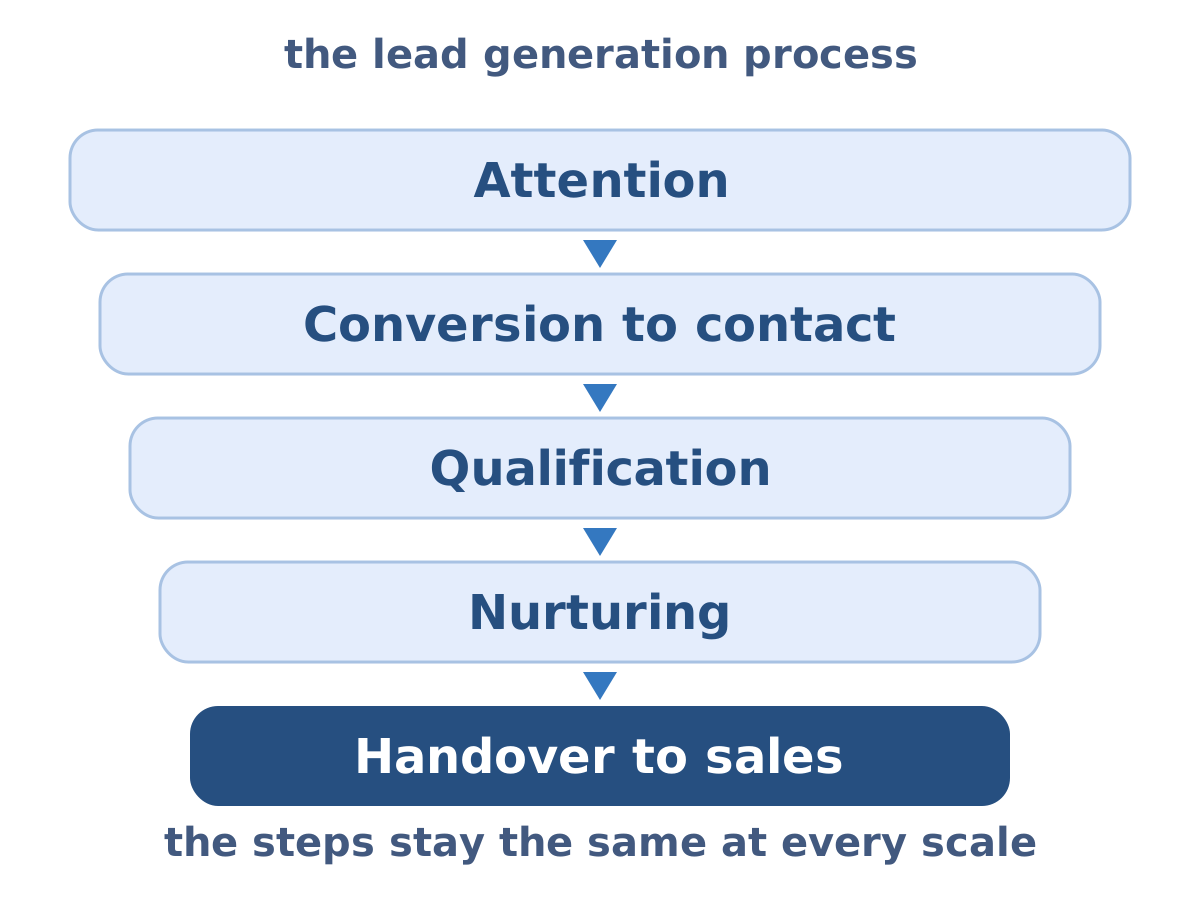
The process runs in five steps, from first contact with the brand to a lead handed to a salesperson:
Attention
A prospect reaches the company's content — from a search engine, an ad, an inbox or a professional network.
Conversion to contact
The visitor leaves details in a form, usually in exchange for something of value: a report, a quotation, a webinar seat.
Qualification
The company assesses whether the lead fits the customer profile and how close it stands to a purchase.
Nurturing
A lead that is not yet ready receives further material until the decision matures.
Handover to sales
A lead ready for a conversation reaches a salesperson together with its interaction history.
The steps stay the same at every scale; what changes is the number of leads and the degree of automation. Each one has its own page in this branch: Lead Generation Funnel orders the stages, Lead Qualification supplies the criteria, Lead Nurturing covers the waiting period, Lead Conversion covers the moment of commitment and Lead Management covers the record that carries all of it.
What are the different types of B2B leads?
B2B leads divide into four types by readiness to buy, and the type determines who touches the lead next.
Cold lead
Has shown initial interest and has no purchasing need yet. Needs education.
Marketing qualified lead (MQL)
Has left details and responds to content, and is not yet ready for a sales conversation. Needs nurturing.
Sales qualified lead (SQL)
States buying intent — asks for an offer or a quotation. Goes to a salesperson.
Product qualified lead (PQL)
Signals intent through product usage rather than marketing engagement, which makes it the most reliable intent signal in businesses that let a buyer try the product first.
A hot lead is an SQL with a deadline attached: the need is defined, the timing is near, and the response time decides the outcome. The type assigned to a lead is the output of qualification, which is why the criteria behind it are worth agreeing with the sales team before the first campaign runs.
What does cost per lead mean for a lead generation programme?
On its own, nothing — a cost per lead is a number only in company with the denominator it was divided by, and the choice of denominator moves the result further than any difference between markets.
The laboratory measured the size of that effect on its own account: one period, one set of markets, one advertising spend, divided three ways, gave a 6.2× spread (drySEO lab data). Nothing about the market changed between the three figures. Only the answer to the question “what counts as a lead” changed.
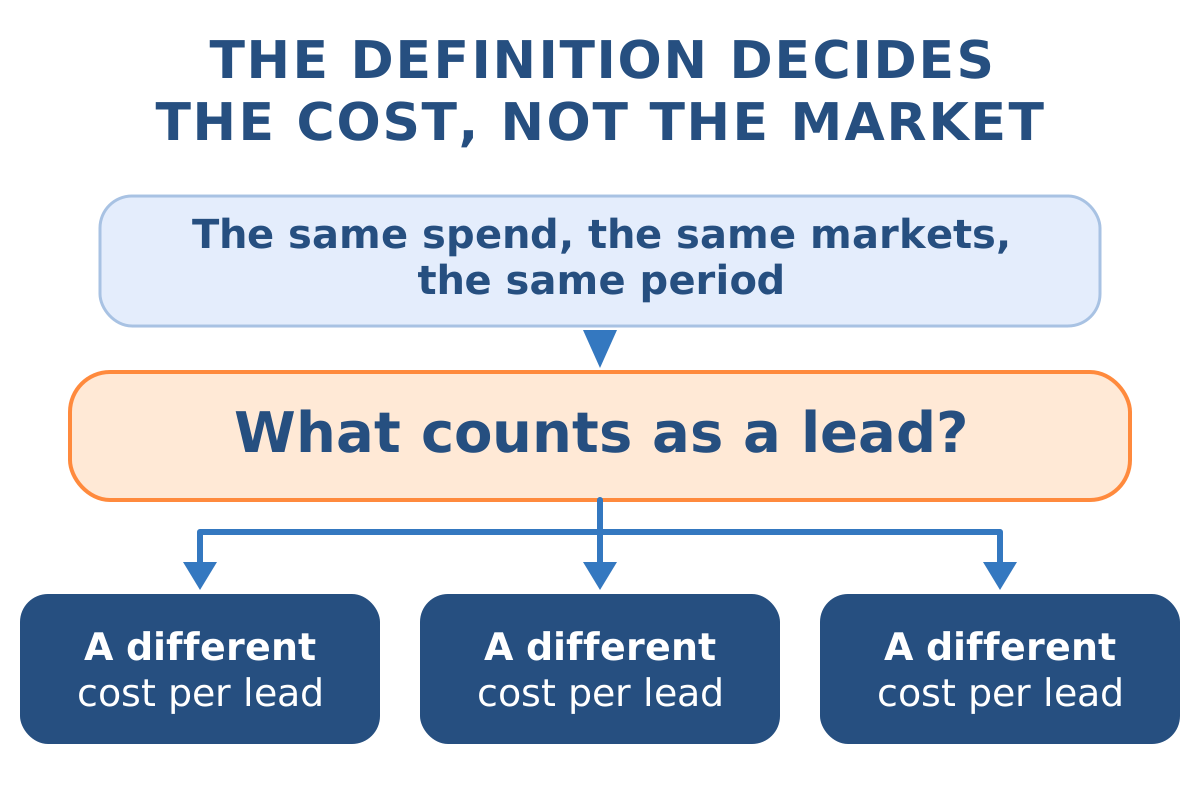
Three consequences follow for a programme, and none of them requires knowing the figures themselves. A budget is planned against one written definition, because a metric whose denominator moves between quarters describes the bookkeeping rather than the market. Comparison runs against your own previous quarters, not against a published benchmark, because a benchmark quoted without its denominator fits almost any account. And a figure read straight from an advertising panel is the most expensive of the available ones — the panel counts fewer conversions than the CRM, consistently in that direction.
The three denominators, the arithmetic behind each, and a calculator that works the figures out on your own numbers are laid out in our cost-per-lead guide.
How can B2B lead quality be improved without lowering volume?
Lead quality rises without a fall in volume when the filtering moves upstream — into who the content speaks to — instead of sitting at the end as a rejection step.
Three practices carry most of the effect in B2B:
- Prospecting on dataDefine the market before the budget is spent: company size, sector, technologies in use, purchasing cycles. Excluding the companies that cannot buy raises the average value of the ones that can, and it does so before any media cost is incurred.
- Lead recyclingThe pool of B2B customers is finite and needs return on a cycle: service, parts, expansion, replacement. A lead acquired once stays in the CRM and re-enters play as the installed product approaches the end of its life, and the salesperson starts that conversation holding the trust built during the first one.
- Qualifying detail in the contentPages that state specifications, limits and comparisons plainly attract the buyer who is ready to check them and hold the attention of the technical reader who will validate the purchase internally. The same detail that makes a page convincing to a qualified buyer makes it uninteresting to a casual one, which raises quality and leaves volume in place among the people who matter.
The measurement gives the reason to care about the ratio rather than the count. On the laboratory's own funnel, 13.6% of commercial enquiries turn into orders — orders divided by commercial enquiries excluding noise, range 11.6–15.0% depending on the denominator (drySEO lab data, measured from full-year exports). At that rate a hundred enquiries carry a forecastable number of orders, and a conversation about budget becomes a conversation about arithmetic.
How does AI search change B2B lead generation?
AI search moves part of the buying research out of a list of links and into a generated answer, which changes where demand appears but not where it is paid for.
The split runs along intent. On informational queries — what something is, how it works, how long it takes — a generated answer increasingly absorbs the click, and the return shifts from traffic to being named. On queries carrying buying intent — a service, a supplier, a category with a B2B qualifier — the buyer still wants to see the vendor and check credibility, so the click and the lead survive.
For a B2B company the money sits on the second kind of query, and that has one practical consequence: a programme does not move budget away from buying-intent work because informational traffic fell. Those are two different populations, and only one of them was ever going to leave contact details. The measurement has to follow suit — a mention without a visit is a result, and it has to be counted separately rather than read as a loss of traffic.
What makes a brand appear inside those answers, and how that visibility is measured, is set out in our AI SEO guide.
What do studies of B2B buying behaviour leave out?
Published research on B2B buying behaviour describes the research phase — how many people take part in a decision, how much of it happens before any supplier is contacted, how many sources a buyer consults along the way. Whatever its method, it reports a population of buyers rather than yours, and it cannot say how a particular enquiry reached a particular company. That last step is the one a lead generation programme is accountable for.
A company's own records answer it, and the answer is narrower than the research makes it sound. Across a full year of commercial case records on the laboratory's account, the channel an enquiry arrived through breaks down as form 87.8%, email 9.7%, everything else below 2% — and on the home market the email share rises to 24% (denominator: all commercial cases in one full year, by the channel-of-origin field; drySEO lab data). Two doors carry almost everything, and the mix between them shifts from market to market inside the same account.
That places the uncertainty where it belongs. What a generated answer absorbs is the stretch of the journey before the door, which no in-house system ever recorded; the arrival itself stays countable and stays where it always was. A programme that responds to AI search by hunting for new places where leads might be landing is searching the half of the problem that was never dark.
How do you measure a lead generation strategy?
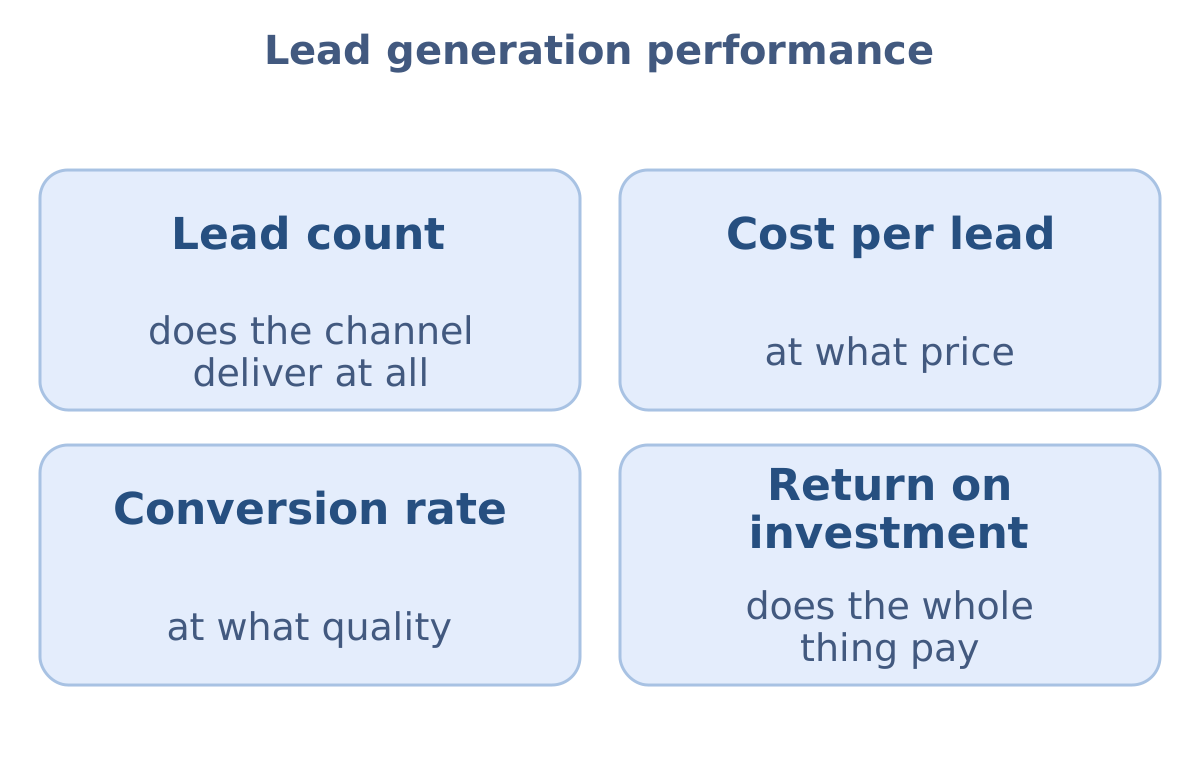
Four metrics answer four different questions: lead count says whether a channel delivers at all, cost per lead says at what price, conversion rate says at what quality, and return on investment says whether the whole thing pays. The questions are independent, and that is the point of them: a channel can deliver plenty, and cheaply, and still not pay — which is why none of the four metrics stands in for the others. The definitions behind the four metrics, and benchmarks set against a year of laboratory data, are in our lead generation metrics guide; a full year of one programme, counted source by source, is in Lead Generation Case Study.
The condition that makes all four usable is agreeing the definitions before the first report, because a metric whose denominator changes between quarters describes the accounting rather than the market. Three definitions are worth writing down explicitly: what counts as a commercial enquiry, which enquiries are excluded as noise, and which system holds the authoritative count.
One widely repeated funnel template is worth checking against your own numbers before it becomes a plan. The template moves 5% of visitors into leads, 30% of leads into qualified leads and closes 15% of those. Measurement on the laboratory's knowledge site puts the first step at 0.7–0.8% — all site users divided by commercial enquiries in the CRM, a ratio that crosses a system boundary and therefore reads as an order of magnitude (drySEO lab data). Against that, the template's first threshold sits 6–7× high, while its closing rate sits well below the measured 13.6%. The 5% figure is realistic for a campaign landing page, where the visitor arrived on a single offer; applying it to a whole knowledge site produces a forecast that overstates the top of the funnel and understates the bottom. Measure the stages separately, each against its own denominator.
How do you plan a lead generation strategy?
A lead generation strategy is a written plan that turns a revenue target into a programme for acquiring contacts: how many leads are needed, from whom, through which channels and at what price. Acquisition run without one breaks into isolated actions — a campaign here, a publication there — that can be neither judged nor scaled.
The document fits on a few pages and holds six elements: a numeric goal (how many leads, of what quality, by when), the target audience, the chosen channels with reasons, the handling process (who does what with a lead, and how fast), the budget, and the metrics with a review cadence. The maturity test is simple: does the document say what the company deliberately does not do. A plan covering every channel and every customer is a wish list.
The goal is calculated backwards. The starting point is the number of customers the company wants to win in a month. Close rate turns that into a number of qualified leads, qualification into a number of leads, and page conversion into the traffic required. Read the other way, the same arithmetic shows what revenue is mathematically reachable on current traffic, and whether the problem sits in traffic, in conversion or in closing; the ratios to substitute come from the measurement step above.
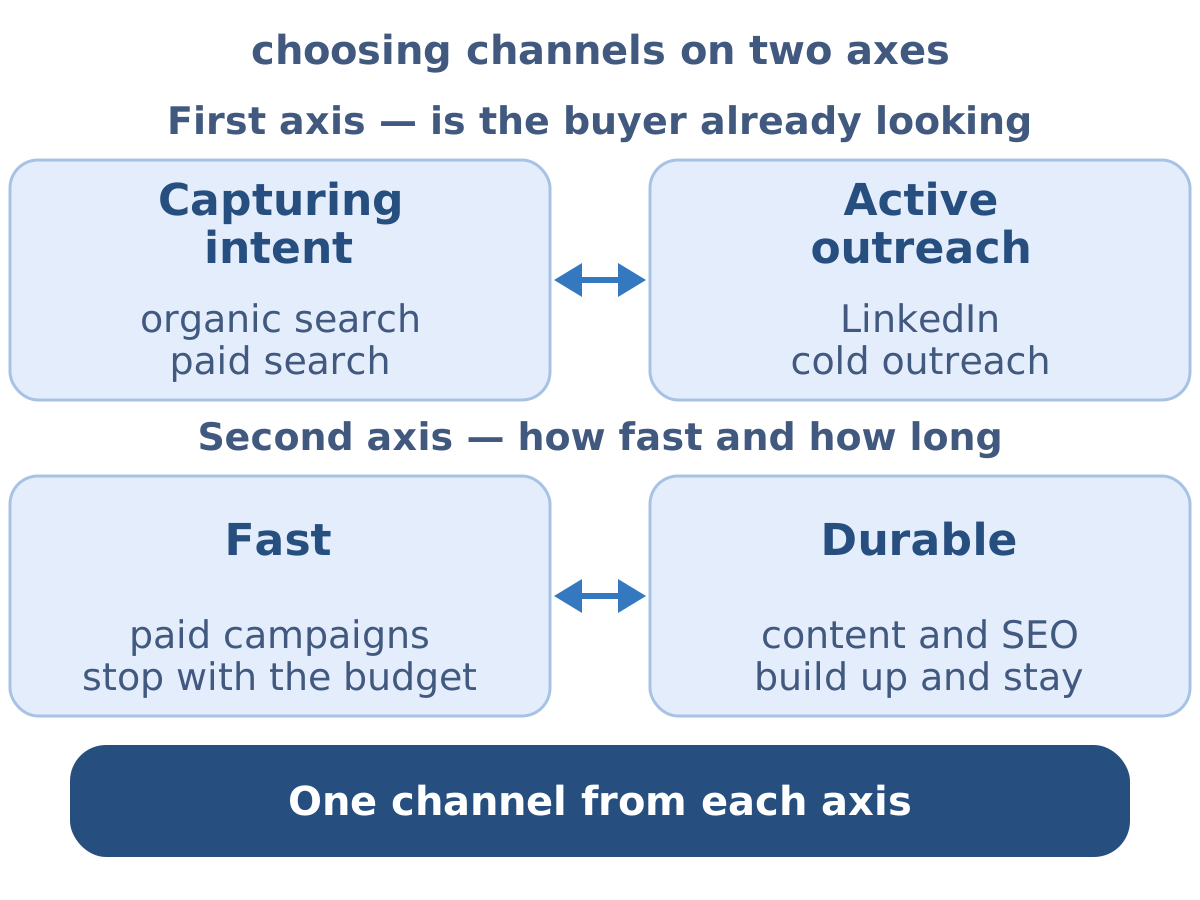
Channels are chosen on two axes. The first: capturing intent versus active outreach — organic and paid search catch those already looking, while LinkedIn and cold outreach reach those who fit the profile but are not searching yet. The second: fast versus durable — paid campaigns deliver leads from the first week and stop with the budget, while content and SEO build over months and stay. A balanced B2B plan takes one channel from each axis and gives each four to six weeks of testing; a verdict issued sooner measures impatience rather than the channel.
Execution is a project, not a document. The strategy gets an owner, a schedule with milestones (channel launch, first review, scaling decision) and a review rhythm: operational monthly, strategic quarterly. Five mistakes recur most often: a strategy without numbers, every channel at once, traffic without a handling process, abandoning a channel before the test ends, and no owner. Planning and judging a campaign step by step is set out in Lead Generation Campaign. A single channel can be outsourced under three conditions that protect the company: the strategy and the numbers stay on its side, the advertising accounts and the data belong to it, and settlement refers to qualified leads. What changes hands in such an arrangement, and how it is settled, is set out on Lead Generation Outsourcing; the alternative, hiring one specialist, is weighed on Lead Generation Specialist: Hire One or Build a System?.
Which mistakes should be avoided in lead generation?
Three beliefs sound reasonable and each has a threshold beyond which it damages results.
“More leads means more sales.” True until quality falls. When salespeople receive contacts with no potential, the cost of handling them rises faster than revenue — a smaller stream of better-matched leads is worth more.
“Cold outreach is cheap, so it always pays.” Per unit, yes. But volume sent to a poorly chosen list lowers the sender domain's reputation and closes the channel for months. Selection works, scale does not.
“SEO is enough, because it is free.” Organic traffic costs nothing per click, but content and optimisation cost time. Below a certain visibility threshold SEO does not repay the outlay — paid search returns faster there, while SEO is built alongside it.
Frequently asked questions
What is a B2B lead?
A company or a decision-maker that has left contact details and shown interest in a product or service. The record becomes useful once it also carries the evidence of that interest — which page, which query, which offer — because that evidence is what qualification works on.
How does B2B lead generation differ from B2C?
In B2B a committee decides, the cycle runs in months and lead quality outweighs volume; in B2C one person decides and speed of conversion carries the result. The consequence is different channels, different content and a different definition of a good lead. The full comparison is in B2C Lead Generation.
What is the difference between demand generation and lead generation?
Demand generation builds awareness of a problem among people who are not yet searching, and it works through content available without a form. Lead generation captures demand that has already been expressed and converts it into a contactable record. The first shows up as growth in brand queries and direct visits; the second shows up as enquiries and their cost. The demand layer is developed in Demand Generation.
How is lead generation work settled?
The lead is the unit, because the lead is the product. External costs — advertising budget and developer time — are paid directly to the supplier, which keeps the cost of the medium separate from the cost of the work on the system. The price of a lead follows from two of your own figures: what an order is worth to you and what share of enquiries closes into one. The full model, including why it runs on margin rather than revenue, is laid out on the page on billing per lead.
How many channels should a B2B company run at once?
One channel that captures existing intent and one that reaches people who fit the profile but are not yet searching, each given four to six weeks before a verdict. A shorter reading mostly measures noise, and a wider launch spreads attention past the point where any single channel can be judged.
Who owns B2B lead generation, marketing or sales?
Both, joined by one artefact: a shared written definition of a qualified lead. With that definition in place, marketing is accountable for the count and the cost, and sales for the close rate. Without it, both sides measure different things and the disagreement about lead quality has no resolvable form.
How long does a lead generation system take to stand up?
Paid search typically returns measurable leads within weeks, organic and AI visibility usually move on a scale of months, and a complete system generally takes around half a year. The three clocks run at once, which is the practical argument for starting the fast channel and the durable one together.