
A lead generation specialist is a collective name for six competencies that in business-to-business companies are usually spread across several people: market research, the search channel, content, measurement, contact automation and the sales conversation. This page is for the owner or director who can see that too few commercial enquiries are arriving and is considering a hire as the answer. Below, the role is broken into its parts, matched against what a typical job advert actually covers, and set beside the case where a ready-made system run from outside reaches the result sooner.
What does a lead generation specialist do?
A lead generation specialist takes a company to the moment where a salesperson is talking to somebody who has a need, a budget and a date. Everything before that moment belongs to the role: choosing the market and the customer profile, being present where that customer looks for a solution, the form that turns a visit into an enquiry, and the sequence of contacts with somebody who is still forming a decision. That whole chain is laid out stage by stage in our guide to B2B lead generation.
The same work appears in job adverts under several names — sales development representative, researcher, new business specialist, lead generation specialist. The title says less than the scope, which is why planning a role is best started from the competencies rather than from the name.
Which competencies make up B2B lead generation?
Six competencies make up the work, and each has a different rhythm and a different way of being measured.
Research and customer profile
Establishing which companies can buy at all: size, sector, technology, buying cycle. Analytical work, judged by the quality of the list rather than its length.
The search channel
Visibility on the queries a buyer types when looking for a solution. This needs technical knowledge of how a search engine works and patience measured in months; how organic traffic turns into commercial enquiries is shown in our SEO leads guide.
Content that answers the buying question
A product description is the starting point; a decision-maker compares, verifies and looks for evidence that the supplier knows the subject.
Measurement
Counting enquiries, cost and close rate always with a denominator — with an answer to “divided by what”. This competency is what separates a report from a table.
Contact automation
Follow-up sequences, activity scoring, order in the contact database.
The sales conversation
Qualification by phone or meeting: establishing whether the need is real.
The first three build the stream. The last three decide how much of that stream reaches an order.
What does a typical job advert leave out?
A job advert usually describes activities and omits ownership of the result and the conditions under which that result is reachable. Four gaps recur.
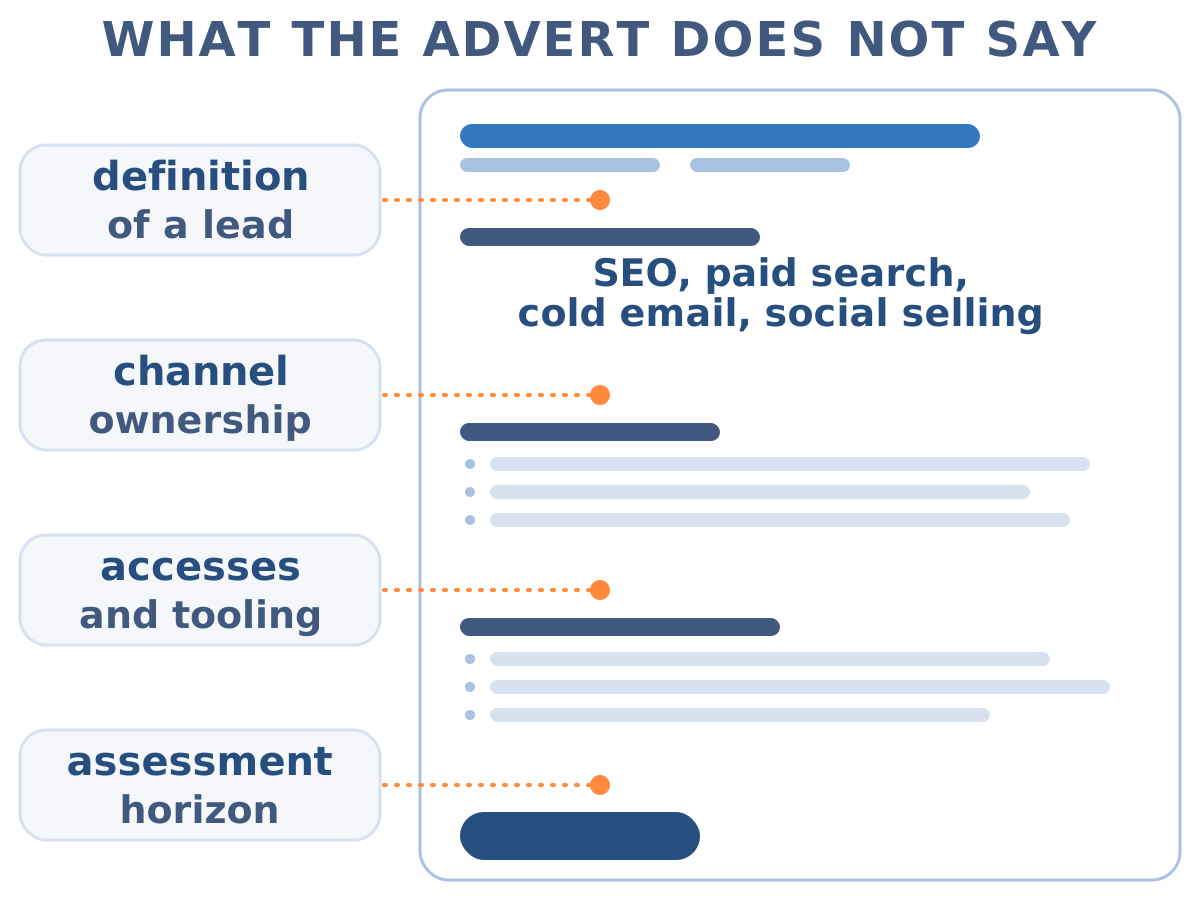
The definition of a lead
“Lead acquisition” without saying what counts as a lead leaves two parties settling up against two different numbers. A request for a quote, a document download and a newsletter sign-up are three different events with three different values. The threshold that sorts them is set in the lead qualification guide.
Ownership of the channel
An advert lists the acquisition channels in one breath, as though they were interchangeable. Each has its own time to result and its own cost of entry, and one person can run at most two of them in parallel.
Access and tooling
Working with measurement requires access to analytics, to the contact database and to the site's code. A new hire who waits a month for those accesses spends that month building lists in a spreadsheet.
The assessment horizon
A role reviewed after one quarter, in a channel that reaches its result after three, ends in a parting and a return to the starting point.
When does hiring a specialist make sense?
A hire pays off when the channel already works and the bottleneck is the number of hands available to handle what it delivers. Three conditions appear together:
- the company has a repeatable stream of enquiries and knows where they come from;
- the sales process is written down, so a new person has something to take over;
- somebody internally can judge the quality of the work on its merits.
Where those hold, a permanent role gives continuity and keeps the knowledge inside the company. The specialist develops a channel that is already producing enquiries, which is a far easier brief than building one.
When does an externally run system reach the result sooner?
An externally run system wins where the channel is still being built and each of the six competencies is needed in a different number of hours per week. The company receives the whole set under one agreement: content architecture, campaigns, measurement, and reporting from the perspective of commercial enquiries. That is the shape of SEO and SEM services at drySEO, a laboratory for search-led lead generation where the methods are tested first on our own B2B account.
The two roads meet over time. A system built from outside remains in the company as a documented process, and a specialist hired later steps into a working structure and develops a live channel from day one.
How should the work be split between a person and a tool?
Tools take repetition, people take judgement. The boundary runs where a rule ends and a decision about the customer's money begins.
| stretch of work | tool | person |
|---|---|---|
| list of companies to contact | filters the database against criteria | sets the criteria and discards false matches |
| follow-up contacts | sends according to a script | writes the script and rules on exceptions |
| activity scoring | counts points for behaviour | decides how many points mean “ready” |
| measurement | collects events | chooses the denominator and explains the gaps |
| qualification call | prepares the context | conducts it and decides |
Automation stops being a convenience and becomes a condition once the number of contacts per customer grows. From laboratory practice (denominator: the number of contacts — call, message, meeting — with one new customer, counted from the date of the first commercial enquiry to the first order; drySEO lab data): an order most often lands on the fifth contact, and sometimes on the twelfth follow-up. With several dozen open threads at once, twelve contacts per customer requires a machine. Which parts of this work can be handed to one is set out in the automation guide.
How is a lead generation specialist's work measured?
The work is measured by the number of commercial enquiries, their cost, and the share that ends in an order — each of those figures stated with its denominator. Site traffic and messages sent describe effort; the order is the result.
The assessment also has to sit in a timeframe that matches a business market. Measured on the lab's last thousand leads, cumulatively: 7.07% of closings came within 3 days, 41.65% within 45 days and 65.96% within 75 days (drySEO lab data — closings ÷ time since the lead's entry; a share of closings, not of leads). Fewer than half of all closings have happened by day 45, and a third of them arrive after day 75. A lead set aside after a month is usually still mid-decision, so a settlement closed on the thirtieth day misses more than half of all closings. How that effort converts into money is shown in our cost-per-lead guide.