
Industrial lead generation is the work of producing requests for quotation from plants, integrators and engineering firms that need what a manufacturer makes. It follows the general rules of B2B lead generation, but four characteristics of the category change how those rules are executed — and getting the execution wrong is expensive here in a way it is not elsewhere.
What is industrial lead generation?
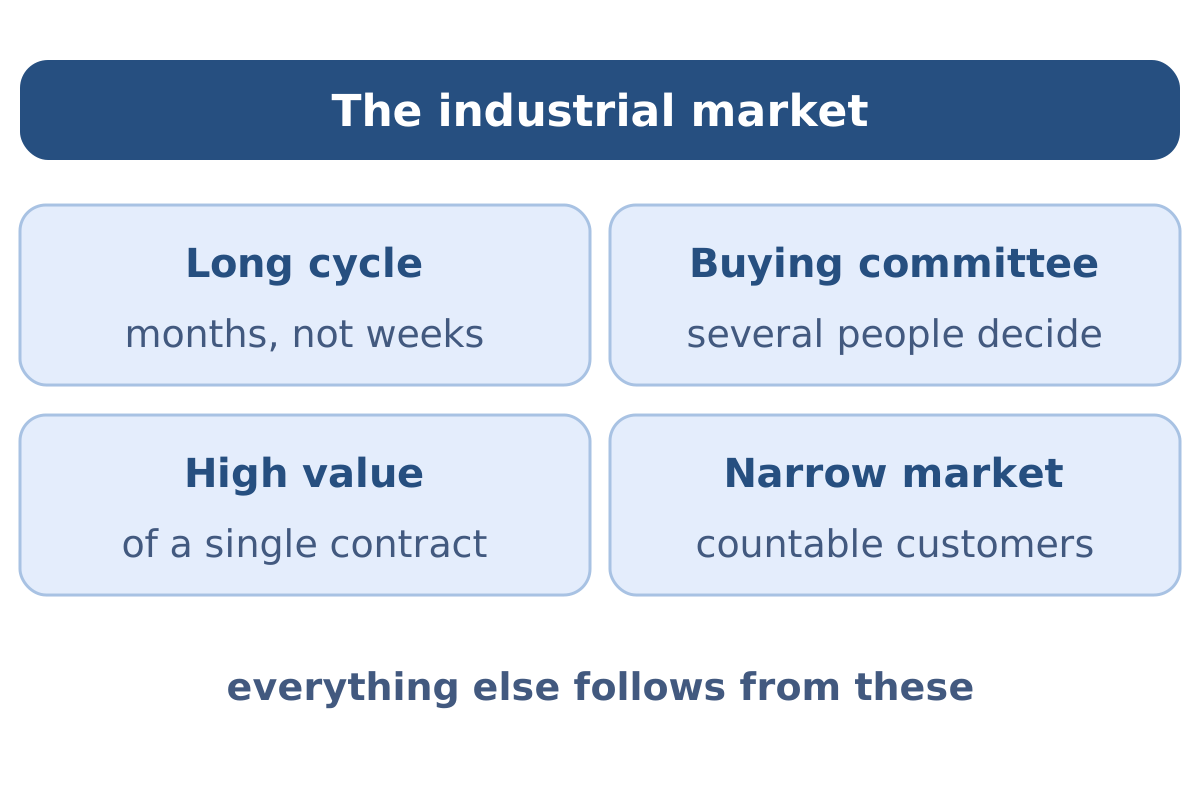
Industrial lead generation is business-to-business lead generation in a market where the buyer is a professional, the purchase is technical, and the decision is made by a group over months. Four features separate it from the rest of B2B.
The buying cycle is long. A capital purchase requires technical evaluation, trials, reference checks and risk assessment, and those steps run at the pace of the buyer's own budget calendar rather than the seller's quarter.
The decision is made by a committee. A request for quotation passes through several pairs of hands, and each pair is looking at something different.
Contract values are high. One well-matched request for quotation is worth more than a hundred casual enquiries, which inverts the usual optimisation: the goal is precision, not volume.
The market is narrow and countable. The realistic buyer universe is often in the hundreds rather than the millions. Every wasted contact measurably depletes the funnel, because there is no long tail to fall back on.
From these four follows the governing rule of the category: the industrial buyer is a professional and expects specifics. Communication built on data, parameters and evidence earns attention; marketing language spends it.
Who decides? The industrial buying committee
The industrial buying committee is the group whose combined approval releases a purchase, and each member evaluates a different risk. Addressing only one of them is the most common reason a promising enquiry goes quiet.
The process engineer or technologist
assesses the specification, compliance with standards and reliability. This person usually starts the search and is the one who found you.
The finance director
calculates return on investment and total cost of ownership. For this reader the purchase price is the beginning of the arithmetic, not the end of it.
The maintenance manager
asks about service, parts availability and response times, because this is the person who lives with the consequences of the choice.
Effective communication addresses all three at once: documentation for the engineer, a total-cost case for finance, service terms for maintenance. The method for building these role profiles, and for writing to each of them separately, is set out in Target Audience.
What channels generate industrial leads?
Four channels produce most of the result in industrial markets, and they work in a specific order — search and content create the demand that the other three convert.
Search and technical content
The engineer begins research in a search engine, using problem-shaped and parameter-shaped queries: how to select a component, what a standard requires, which specification suits a duty. Pages that answer those queries with actual numbers are the cheapest entrances to the funnel a manufacturer has. How that traffic becomes a commercial enquiry rather than a page view is covered in our guide to SEO leads.
Trade shows with digital follow-through
Trade shows remain central in industry, but their role has changed: the visitor arrives to verify a supplier already found online. The return on a show is therefore decided by the follow-up, and the contacts collected have to enter the process within days.
Prospecting on industry data
A narrow market rewards list work. Trade registers, plant directories and association membership lists make it possible to build a named list of facilities matching the profile, and to write to them about something specific.
Professional networks and tightly targeted paid campaigns
Professional networks reach technical roles and management directly, and paid search works on precise product and parameter queries. Broad campaigns burn budget in this category, because the audience is mostly people who will never buy.
What does a request-for-quotation platform change about the enquiry?
A fifth route runs alongside those four and behaves unlike them: the request-for-quotation platform, where a buyer publishes a specification and suppliers answer it. The enquiry arrives without the supplier having been found first, and three things change at once because of it.
These venues have names, and a buyer describing this route will use them rather than the generic term. Europages and Thomasnet are supplier directories with a request-for-quotation function attached. TED, the European Union's register of public procurement notices, is not a marketplace at all, but it reaches a supplier the same way: the specification is published, the closing date is fixed, and whoever answers is answering a document that was already written. Which of the three a manufacturer meets depends on its sector and on the markets it sells into, and all three sit outside the route in which a supplier is found first.
The buyer initiates, and the specification is already written
In search the supplier is found during the buyer's research, early enough for its documentation to shape what ends up being specified. On a quotation platform the specification arrives finished, and the variables left are price, lead time and compliance with what somebody else wrote. Whatever influence the marketing work could have had on the specification happened — or failed to happen — quarters earlier.
The request is competitive by construction
An enquiry from search reaches one supplier at a time. A published request reaches every supplier matching the category, and the buyer compares them side by side on the fields the platform asks for. How many competing quotes sit beside yours is a property of the platform, not of the offer.
Its close rate therefore belongs to a different population
An enquiry from a search visit and a request from a quotation platform are not the same unit. Averaged together they produce a close rate that describes neither, and that average moves whenever the mix between the two moves rather than when anything about the selling changes. Counted apart, each gets a denominator that holds. No figure for the platform channel appears on this site, because the laboratory's measurement does not contain one.
A published tender is the same mechanism with the rules written down: the specification is fixed before any supplier is contacted, and commercial contact during the procedure is restricted.
What technical content brings in requests for quotation?
Technical content produces enquiries when it gives the engineer something usable before asking for anything. Four formats do the work.
Specifications and documentation available without a form. An engineer who is asked to fill in a form to see a datasheet will go to a competitor who publishes one. Open documentation is a lead generation decision, not a concession.
Case studies with numbers. Problem, solution, parameters before and after. This is the format that survives circulation inside the buyer's organisation, because it is what the engineer forwards to finance.
Selection tools and calculators. A tool that helps match a product to a duty does qualification and lead capture in one motion, and it ends naturally in an enquiry because the user has already specified their application.
Problem-led guides. Written against the queries engineers actually type, rather than against the product names the manufacturer uses internally.
Gating is worth it only for premium material — substantial reports and interactive tools — and never for basic documentation. What to put behind a form and what a form has to offer to be worth filling in is the subject of the lead magnet page.
How does industrial lead generation differ in the public sector?
Selling to the public sector changes the timing of the work rather than its substance: public buyers purchase through tender, criteria are formal, budgets are published, and commercial contact during a procedure is restricted. Lead generation therefore happens before the tender exists.
In practice this means educating the people who write specifications, appearing in reference documentation, and building the position of a supplier whose parameters end up in the requirements. A firm that first learns of a tender from its publication is usually competing on price alone — the marketing work that decides the outcome happened quarters earlier.
How do you nurture a lead through a long buying cycle?
An industrial enquiry rarely becomes an order in the same quarter, so the lead has to be kept alive through stages the seller does not control: trials, budgeting, board approval. Nurturing supplies technical substance during that period — architectures, comparisons, implementation results — rather than commercial reminders.
One observation from drySEO lab practice describes the contact cadence through this wait, and it serves as a planning assumption for a programme. It is directional — a pattern from inbound B2B experience, distinct from the measured figures on this site, which carry denominators. Conversion of a new client typically follows the fifth contact, with sequences running to twelve follow-ups. Its operational conclusion transfers cleanly: a cadence of five to twelve contacts has to be carried by a system. The systems that do this are covered in the automation guide.
Measuring the decision window. That window is long. Measured on the lab's last thousand leads, cumulatively: 7.07% of closings came within 3 days, 41.65% within 45 days and 65.96% within 75 days (drySEO lab data — closings ÷ time since the lead's entry; a share of closings, not of leads). Fewer than half of all closings have happened by day 45, and a third of them arrive after day 75. A lead that has gone quiet after a month is still live, and more than half of all closings fall after day 45.
How do you measure industrial lead generation?
Industrial lead generation is measured on cost per acquired contract rather than cost per contact, because the contract values are large enough that a single match repays a long series of expensive enquiries. The per-contact figure still has to be tracked — it is how channels are compared — but it is not the number that decides whether the programme works.
One measurement rule is worth stating plainly, because it changes budget decisions. Advertising and analytics panels report only what they can attribute, and in drySEO lab data the comparison of enquiries carrying a campaign parameter in the CRM against the panel's own conversion count gives a ratio of 1.4–1.9×, always in the same direction: the panel sees fewer (denominator: campaign-parameter leads in the CRM ÷ conversions reported by the panel; a control from a third system agreed within 0.4 percentage points; drySEO lab data). Treat the panel number as a floor and reconcile it against the system where orders are recorded before moving budget.
What are the most common mistakes in industrial marketing?
The four recurring failures in industrial lead generation are all failures of audience, and each has a direct fix.
The first is marketing content where technical content belongs: the engineer reads parameters, so give parameters. The second is the missing follow-up after a trade show, where collected contacts age faster than anything else in the funnel. The third is communicating with one contact instead of with the committee, which leaves the project dependent on a single champion who may change jobs. The fourth is gating basic documentation, which pushes the engineer to whichever competitor publishes an open datasheet.
Building the search, content and measurement layers that avoid all four is the work described in our SEO and SEM services.