
Demand generation is the work of creating awareness of a problem and of your category's answer to it, among people who are not yet looking for a supplier. It sits one layer above contact capture: by the time someone fills in a form they have already decided the problem is worth solving, and demand generation is what produced that decision. The layer below it — turning that interest into named, workable contacts — is mapped in our guide to B2B lead generation.
What is demand generation?
Demand generation is a marketing discipline that builds recognition of a problem, trust in a category and familiarity with a brand, so that when a purchase decision starts the buyer already knows who to consider. It operates on the part of the market that has no active search query, which is most of the market most of the time.
Three properties distinguish it as a discipline.
It works on a population, not on individuals. Demand generation succeeds when a market's understanding shifts, which is measured in aggregate rather than per contact.
Its effect is delayed and durable. The awareness created in one quarter produces enquiries in a later one, which makes attribution hard and makes the work easy to underfund.
It precedes intent rather than serving it. A buyer already comparing suppliers is responding to demand that exists; demand generation addresses the period before that, when the buyer has a problem they have not yet named.
What is the difference between demand generation and lead generation?
Demand generation creates and shapes interest; lead generation converts that interest into named contacts a sales team can work. They are two consecutive layers of the same system, and the distinction is about function rather than about which is superior.
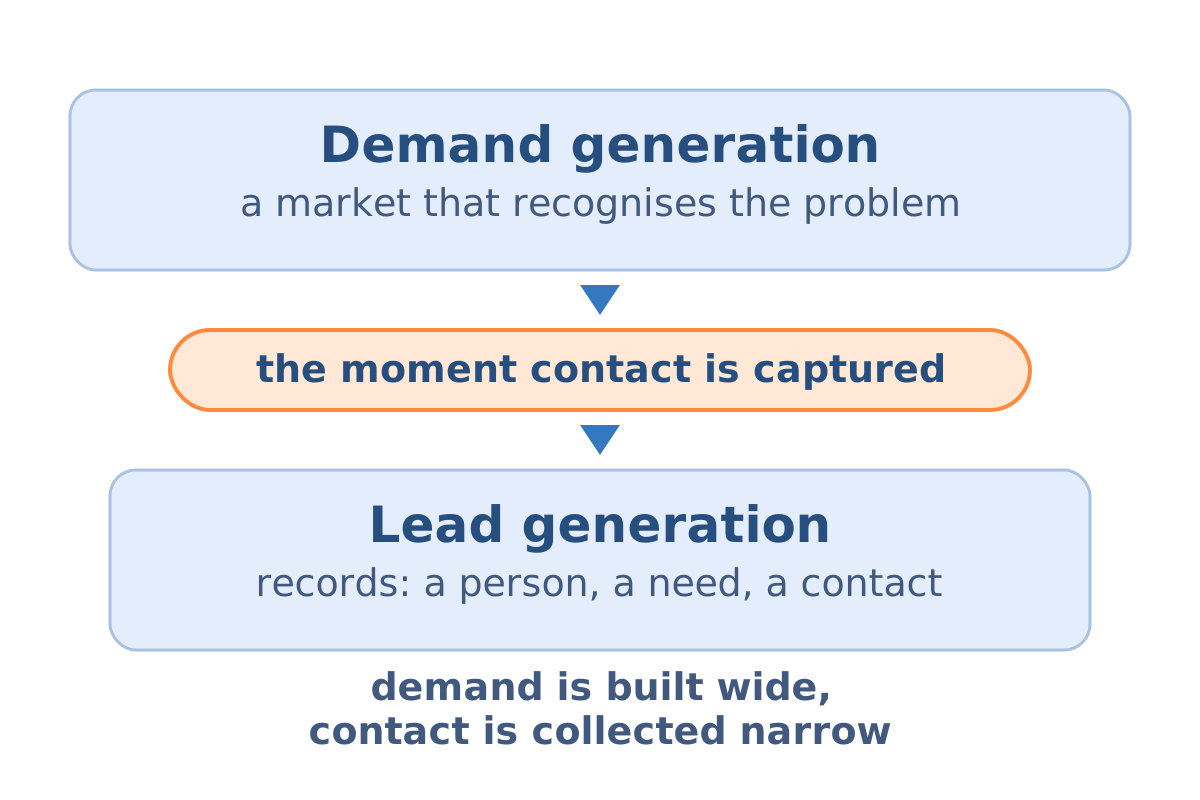
The clearest way to see the split is through what each one produces. Demand generation produces an informed market: people who recognise a problem, know that a category of solution exists, and associate a name with it. Lead generation produces records: a person, an organisation, a stated need and a route to contact them.
The consequences for how each is run follow directly:
Different time horizons
Demand generation is assessed over quarters; lead capture is assessed over weeks.
Different metrics
Demand generation is read in branded search volume, direct traffic, share of voice and the composition of who arrives. Lead generation is read in enquiries and close rate.
Different content
Demand generation content explains a problem and is freely available, because gating it would defeat its purpose. Lead generation content answers a supplier question and may reasonably ask for something in return.
A practical way to hold both: run demand generation ungated and wide, run lead capture gated and narrow, and connect them so that the person who read the explanation can find the offer when they are ready. What that offer looks like and what it has to be worth to justify a form is set out on the lead magnet page.
What is B2B demand generation?
B2B demand generation is the same discipline applied to a market where purchases are made by groups, cycles run for months or years, and the buyer population for any given product is small enough to be countable. Those three conditions change the execution substantially.
Because the buyer is a committee, demand has to be generated in several heads at once. The engineer who will evaluate the solution, the executive who will approve it and the team who will use it each need to arrive at the recognition separately, and each responds to different material.
Because the cycle is long, the majority of any B2B market is out of the market at any given moment. Effort aimed exclusively at the small share currently buying competes with every rival for the same narrow attention, while the far larger share forming impressions for a future purchase goes unaddressed.
Because the population is countable, reach can be deliberate. A B2B firm can often name the few hundred organisations that could plausibly buy, which turns demand generation from broadcast into something closer to sustained coverage of a known audience. How that audience is defined and divided is covered in B2B Target Audience.
Why is demand generation important for B2B businesses?
Demand generation matters in B2B because it determines the quality of everything downstream: a market that already understands the problem produces enquiries that close, while an uninformed market produces enquiries that have to be educated at the sales team's expense.
There is also a measured argument, and it comes from an unexpected direction. In drySEO lab data, a knowledge-led site attracted traffic from 243 countries, commercial enquiries arrived from 185, while advertising reached 22 (denominator: countries with recorded traffic, with a commercial enquiry, and with advertising spend, over one year; drySEO lab data). The gap between 185 and 22 is demand generation stated as a number: enquiries arrived from more than eight times as many markets as were ever advertised in, because the content had already done the work of creating recognition in places where no budget was spent.
The same measurement carries a second, sharper finding about where demand comes from. Comparing a home market with a distant Western one, the cost per click ran 4.2× higher and the cost per lead for the market 3.1× higher — yet the proportion of that market's leads actually produced by advertising reversed: in the home market advertising delivered 6% of the market's leads, in the distant market 43% (drySEO lab data; denominators: cost ÷ clicks summed across rows, and leads carrying a campaign parameter ÷ all leads from that market). Read plainly, this says that in the market where the brand was already known, organic demand supplied almost all of the leads; in the newer market, advertising was carrying almost half the load at several times the price. The cost of arriving somewhere before demand generation does is legible in the advertising invoice.
What are examples of demand generation activities?
Demand generation activities share one feature: they give something away to people who have identified themselves as nothing more than interested. Six formats carry most of the work in B2B.
Educational content on the problem
published openly and written for someone who has the problem but lacks the vocabulary for it. This is the foundation, and it is what search rewards.
Original research and measurement
data that exists nowhere else creates recognition faster than any other format, because it gives other people a reason to cite you. A single defensible measurement with a stated denominator outperforms a year of commentary.
Long-form explanation in the buyer's own channels
technical talks, webinars, podcast appearances, conference sessions — where attention is given voluntarily and at length.
Video demonstration
in drySEO lab practice a video channel grew +300% over twelve months and was the clearest leader among social channels — a directional figure from experience, distinct from the measured data above, which carries denominators. The mechanism behind it is worth more than the figure: video shows a product in operation, which is the fastest route to problem recognition for a technical buyer.
Presence in professional communities
where reputation is built in public and cannot be purchased.
Consistent brand positioning
so that the recognition created by all of the above accumulates against one name rather than dispersing.
A pattern worth naming runs through several of these. In drySEO lab practice, social channels produced roughly 2× as many interactions as the site had users, with conversion happening on the destination page — a directional figure from experience. These channels are stops on a journey, and the useful conclusion is to treat them as demand generation and to send the resulting attention somewhere that can capture it.
How does demand generation work?
Demand generation works through repeated, useful exposure that shifts a population from unawareness to recognition, and then hands that recognition to a capture mechanism. The sequence has four stages.
Problem framing
The market is shown a problem it recognises but has not articulated. This is the stage most often skipped, and skipping it produces content that answers questions nobody has yet asked.
Category education
The reader learns that a class of solution exists and what distinguishes good from poor within it. Doing this honestly — including where the category is a poor fit — is what makes the source credible.
Brand association
The name doing the explaining becomes the name attached to the category in the reader's memory. This is the asset; everything else is the method of building it.
Hand-off to capture
The interested reader encounters a reason to identify themselves, at a moment they choose.
The measured reality of the hand-off deserves attention, because it is where expectations are usually wrong. A knowledge-led site converts visits to commercial enquiries at 0.8% — 0.7% after noise is removed (denominator: all site users ÷ commercial enquiries in the CRM; drySEO lab data). That figure looks poor against the 5% that circulates in funnel templates, and the comparison is a category error: 5% describes a campaign landing page addressing people already in the market, while a knowledge site is addressing the whole population, most of whom are doing exactly what demand generation intends. The low percentage is a consequence of a wide denominator, and it is the arithmetic signature of a page doing its job.
What are the key components of a demand generation strategy?
A demand generation strategy needs five components, and omitting any one of them produces a recognisable failure mode.
A defined audience
including the share of it not currently buying. Without this, effort collects around the visible minority in the market.
A problem thesis
the specific recognition you are trying to create. A strategy aiming to create general awareness creates none.
A content and channel plan
matched to where the audience actually gives attention, rather than to where content is easiest to produce.
A capture layer
that is ready when recognition converts, so that demand created is demand collected rather than demand handed to whoever ranks.
A measurement design
established before the work starts, because the effects are delayed and cannot be reconstructed afterwards.
The capture layer is where demand generation meets the rest of the site, and the search channel is the largest single route between the two. How that channel is built and run is set out in the SEO guide.
How do you measure demand generation ROI?
Demand generation is measured on leading indicators of recognition and on the composition of demand arriving, because the direct conversion metrics used for lead capture systematically undervalue it. Four measurements do most of the work.
Branded search volume is the cleanest single indicator: people searching for your name have been reached by something. Direct and returning traffic shows recognition converting into deliberate visits. The breadth of demand — how many markets, industries or segments enquiries arrive from — shows reach extending. And the share of enquiries that arrive already informed, which sales can report even where analytics cannot, shows the quality of the recognition being created.
Two cautions belong with these numbers.
The first is attribution. Advertising and analytics panels report only what they can attribute, and in drySEO lab data the ratio of enquiries carrying a campaign parameter in the CRM to conversions reported by the panel is 1.4–1.9×, always in the same direction: the panel sees fewer (denominator: campaign-parameter leads in the CRM ÷ panel conversions; a control from a third system agreed within 0.4 percentage points; drySEO lab data). Demand generation suffers most from this, because its effect arrives through channels that carry no parameter at all.
The second is the size of the unattributed pool. In the same account, 46.2% of advertising budget carried no country attribution, of which 27.1% came from campaign types with no geography at all (denominator: cost with no named country ÷ total account cost; drySEO lab data). A measurement system with a gap that size will always understate work whose effect is diffuse.
The metric definitions that make these reconciliations possible are set out in the lead conversion guide.
How is demand generation changing as buyers use AI assistants?
Demand generation is changing because a growing share of problem research now begins in conversational AI interfaces, where an answer is composed from sources rather than presented as a list of links. For a discipline whose product is recognition, this shifts what the asset has to be.
Two consequences follow. Content structured so that a self-contained passage answers one question completely is more likely to be drawn on as a source, which keeps a brand in circulation even in exchanges that produce no click. And material a model cannot assemble from everyone else's marketing — original measurement, stated denominators, experience from actual implementations — is what distinguishes a citable source from a redundant one. What that requires technically is covered in our AI SEO guide.
Where demand generation meets the rest of the work
Demand generation earns its budget when the capture layer beneath it is ready, the search channel connecting them is built, and the measurement spans both. Assembling those three is the work described in our SEO and SEM services.