
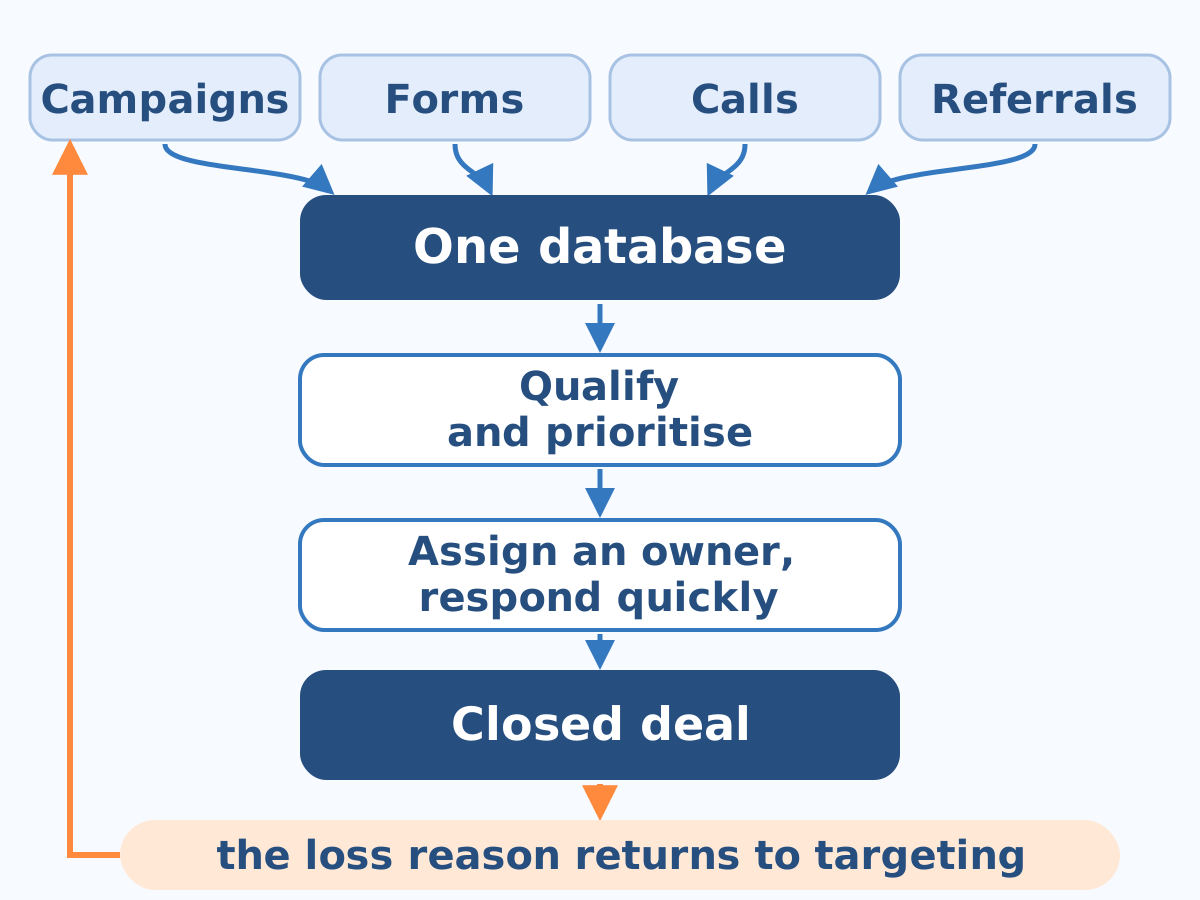
Lead management is the process of handling acquired contacts: from the moment a record is created, through qualification and assignment, to a closed transaction. Lead generation attracts contacts; lead management decides what happens to them next.
The difference is one of direction. Generation works outward and brings new contacts in; management works inward and turns collected contacts into revenue. This page covers the process in five steps, the role of a CRM, what a lead manager actually does, the metrics that show whether the process is healthy, and how lead management differs from the two things it is most often confused with.
What is lead management?
Lead management is the structured handling of every potential customer in the database: who is responsible for the contact, what status it holds, what the next step is, and what previous conversations established.
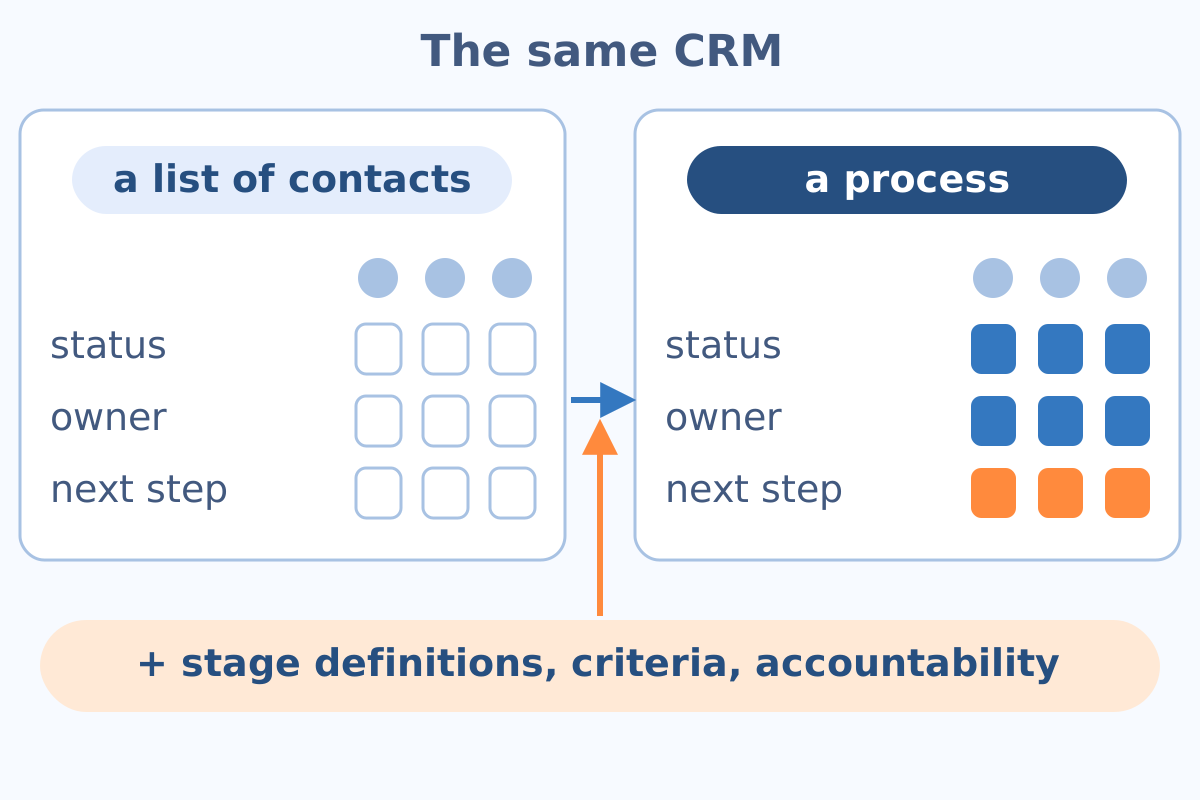
A common misunderstanding is worth naming early, because it shapes the rest of the page: installing a CRM is often taken to mean lead management is in place. The CRM is the tool and lead management is the process. A system with defined stages, criteria and accountability manages leads; a system without them holds an orderly list of contacts. The process begins working at the point where every lead has an owner and a rule for moving forward.
What are the steps in the lead management process?
The process runs in five steps, and each one closes a specific route by which leads are lost.
- Collect leads in one database. Contacts from forms, campaigns, calls and referrals arrive automatically in a single system. Dispersal across inboxes and spreadsheets is the first cause of lost leads, and it is the one that grows fastest with headcount.
- Qualify and prioritise. An assessment of fit and readiness sets the order in which salespeople work, as covered in the lead qualification guide.
- Assign and respond quickly. Every qualified lead receives an owner through routing, and a fast first contact. A lead cools by the hour, and response time is the simplest metric in the whole process to improve.
- Mature the leads that are early. Contacts with potential but no present readiness enter an education programme rather than a closed status.
- Analyse and close the loop. Every lost lead is recorded with a reason — price, competitor, no need — and the conclusions return to targeting and campaign planning.
In daily practice leads are classified by three temperatures: hot (clear purchase intent, contact immediately), warm (interested, needs conversations and content) and cold (inactive, occasional communication). That classification is coarse and sufficient: it tells a salesperson where to start the day.
What does a lead manager do?
A lead manager owns the process rather than the individual deals: the definitions, the routing rules, the data quality and the reporting that tells everyone whether the system is working.
The role concentrates on five responsibilities:
Maintains the stage definitions
and the criteria for moving between them, keeping marketing and sales working from one taxonomy.
Owns routing and response-time policy
who receives which lead, how fast, and what happens when the owner is unavailable.
Guards data quality
since every metric downstream inherits the condition of the records.
Runs the feedback loop
collecting loss reasons and returning them to targeting so campaigns improve on evidence.
Reports the process
with each metric carrying its definition, so figures stay comparable across quarters.
In smaller companies this is a part of a marketing or sales leader's role rather than a separate post. The work exists regardless of the job title, and where nobody holds it, the symptoms are consistent: statuses that mean different things to different people, leads waiting for an owner, and loss reasons that are blank.
What happens to a lead in the first minutes after submission?
In the first minutes a lead passes through the backstage layer.
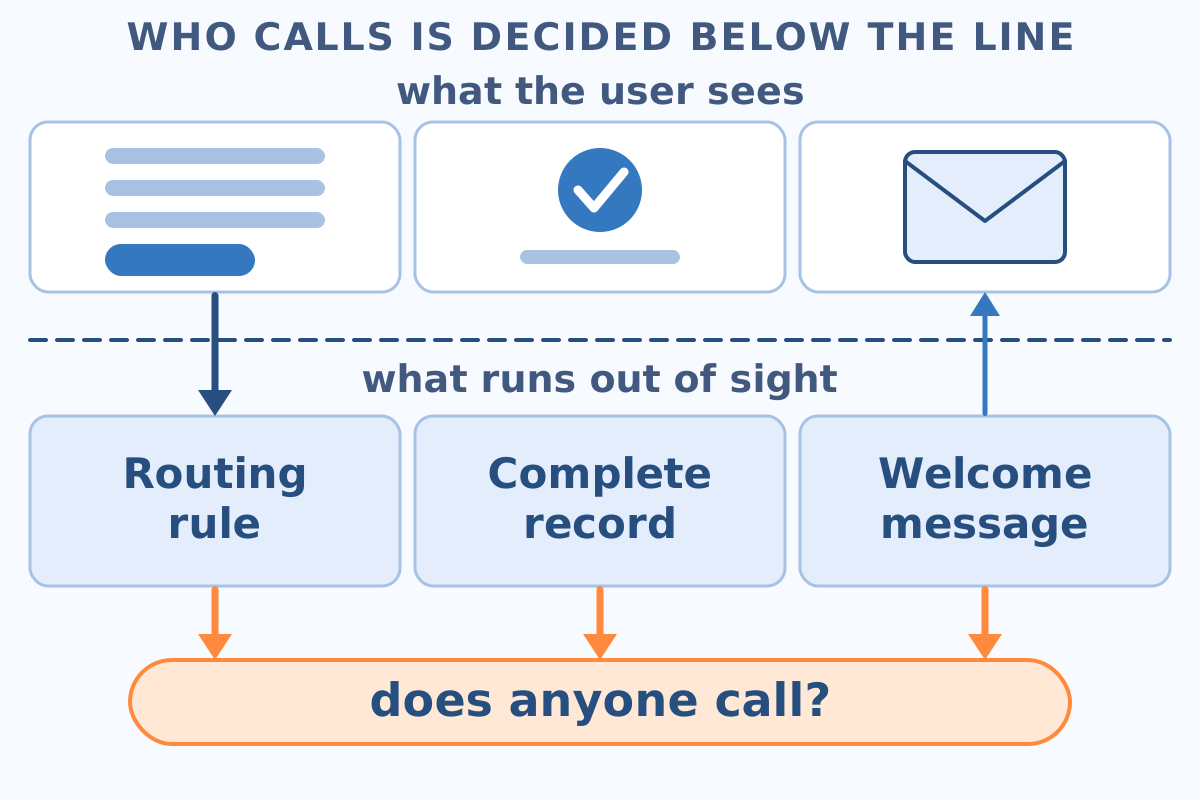
Three parts of that layer are configured once and then work on every submission.
- The routing rule. Ownership follows a rule — market, segment, product, duty roster — where a shared inbox spreads responsibility across everyone. The rule needs a fallback for an owner who is away.
- The automated welcome message. It delivers the promised item within seconds and states who will make contact and when. It is the one contact guaranteed to arrive while the lead is still warm.
- A complete record. Source, campaign parameter, the text of the enquiry and the page it came from are written alongside the contact. A field left empty at that moment is lost to reporting permanently.
How does the handover from marketing to sales work?
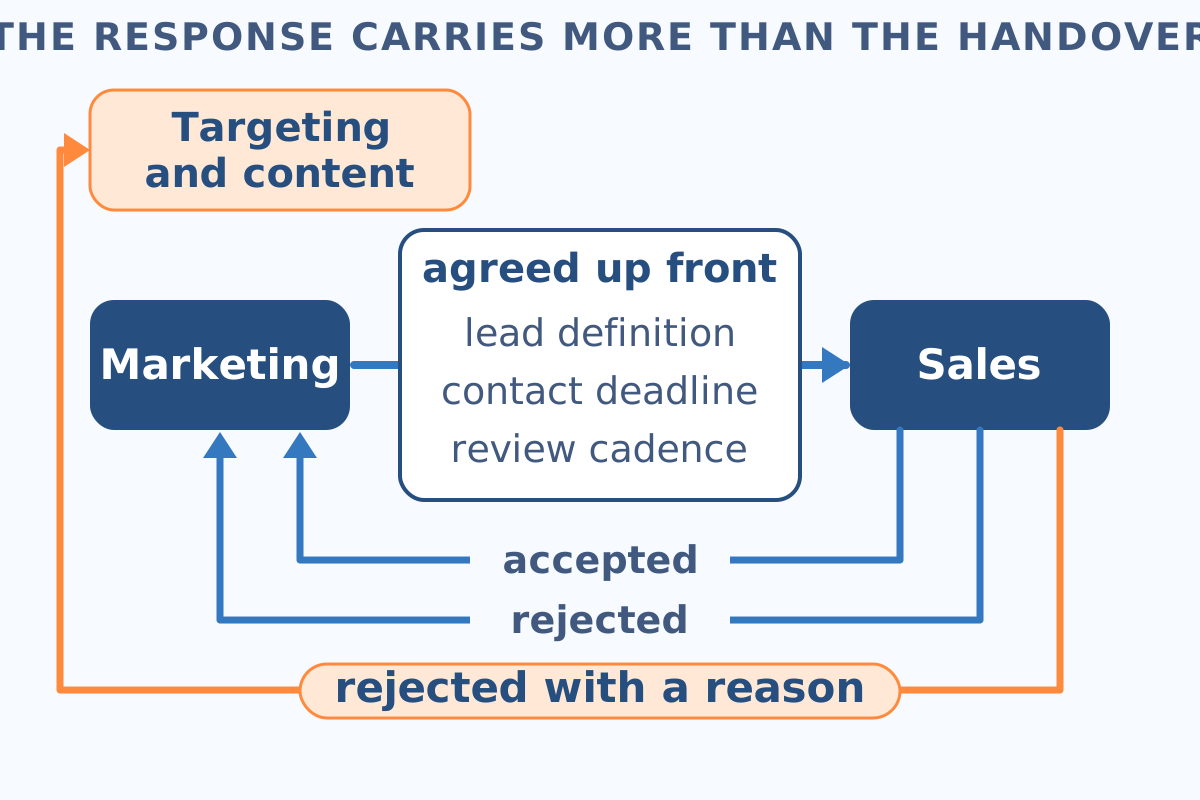
The handover works as a step of its own, with its own criterion and its own deadline, and it is where a funnel loses the most contacts for the least expensive repair. Four agreements make it hold: a shared definition of a qualified lead, a maximum time to first contact, a format for the response from sales (accepted, rejected, rejected with a reason), and a review of those figures on a fixed cadence.
The response is the part that carries the weight, because it closes the loop. A rejection reason travels back to targeting and to the content, and the argument about lead quality gets settled on figures drawn from one system.
How do you find the bottleneck in a lead process?
Find the bottleneck by counting how many leads sit at each stage and how long they have been sitting there: the stage where records pile up or age sets the pace of everything downstream. A pipeline view shows it directly, provided statuses are current and transition dates are written automatically.
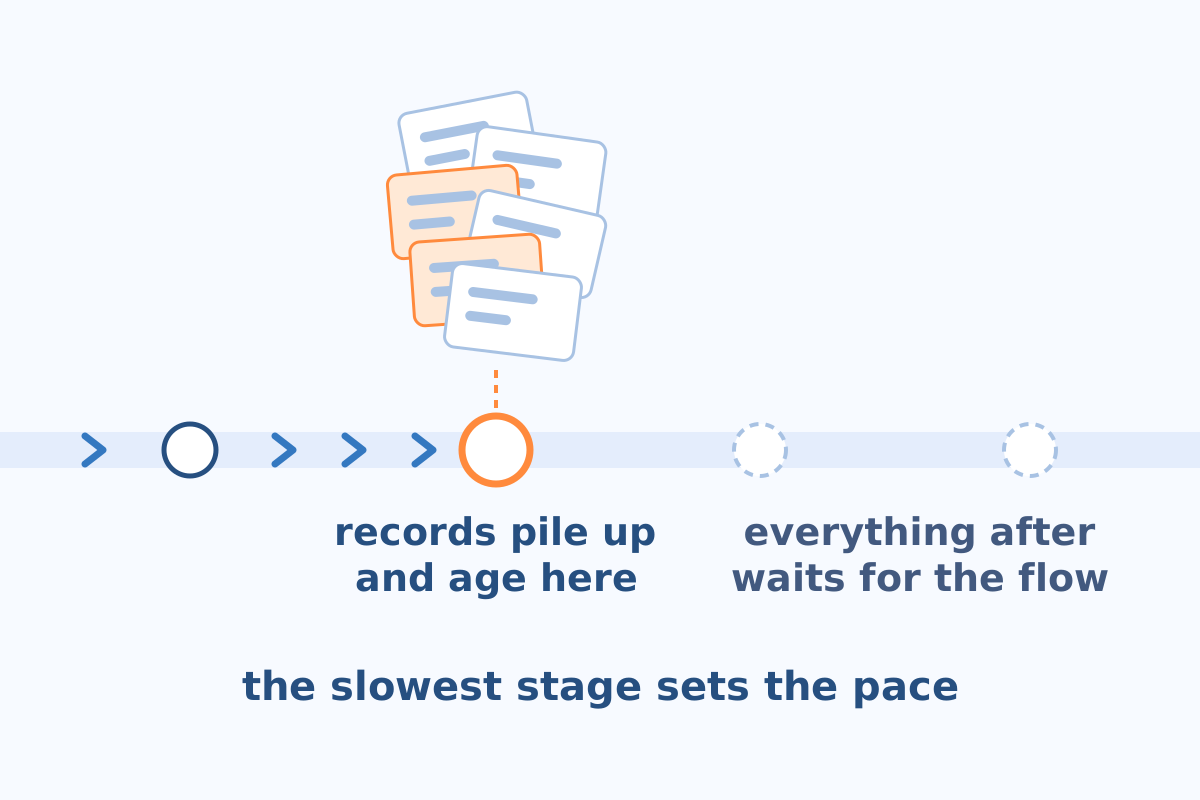
This is the supporting layer of the process — the analytics and the report: record age by stage, response time broken down by owner, and stage-to-stage conversion counted under one definition month after month. The layer serves backstage and front-stage at once, since a fix applied at the stage that surfaced as the bottleneck shortens the wait on both sides of the form.
How does CRM software support lead management?
A CRM supports lead management by holding the record and enforcing the rules: it stores contact details and interaction history, maintains statuses and assignments, displays the pipeline as open opportunities distributed across stages, and counts the transitions between them.
Two views come out of the same data. A salesperson sees what happened with a lead before making the call. A manager sees how many opportunities sit at each stage and where the process is slowing.
When choosing lead management software, four properties decide more than the feature list:
Integration with lead sources
forms, email and phone should create records automatically through a web-to-lead path, with no manual retyping.
Status automation
scoring rules and stage transitions, so the system enforces the process rather than only recording it.
Transition reporting
conversions between stages and response times available without exporting to a spreadsheet.
Pricing that matches the team
a simple cloud CRM covers small and mid-sized companies, while enterprise platforms repay their overhead at large team sizes and volumes.
The class of tool matters less than the discipline of use. A CRM where conversations go unrecorded manages nothing, which is why adoption is the implementation risk worth planning for rather than feature coverage.
How much does lead management software cost?
Lead management software is priced in three common shapes, and knowing which shape you are buying predicts the total cost better than any headline figure.
- Per user per month — the most common model. Cost scales with team size, which suits a growing sales team and penalises giving read-only access widely.
- Per contact or per record — cost scales with database size. This model interacts badly with poor data hygiene, since duplicates and dead records are billable.
- Tiered by capability — a low entry tier with automation, reporting or integrations placed in higher tiers. The trap here is discovering that the one rule you need sits two tiers up.
No figures appear on this page, for a reason worth stating plainly: software pricing changes continuously and varies by region, contract length and negotiation, so any number published here would be stale and unverifiable. The durable advice is structural — establish which of the three shapes applies, project it against your team size and database size in two years rather than today, and confirm which tier contains the automation rules your process depends on.
What is the difference between lead management, lead generation and pipeline management?
The three cover consecutive parts of the same commercial motion, and the distinction is worth holding because each fails differently and is fixed differently.
- Lead generation works before a contact exists: content, campaigns, search. It fills the funnel and is measured on volume and cost.
- Lead management works after the contact exists and across the whole route: qualification, routing, nurturing, loss reasons. It is measured on transitions and response times.
- Pipeline management is the narrower discipline at the end: the open opportunities a salesperson is working, measured on deal value, stage age and forecast accuracy.
Reading the symptom against this list gives the diagnosis. Too few contacts at any price is a generation problem. Plenty of contacts and few conversations is a management problem. Plenty of conversations and an unreliable forecast is a pipeline problem. The habit of treating all three as “we need more leads” is what sends budget to the one part of the chain that was already working.
Which lead management metrics should you track?
Four metrics show the health of the process, and each one exposes a different failure.
Cost per lead
says what entry to the funnel costs — and it means nothing without its denominator. Measurement on the drySEO laboratory's own account returned PLN 73, PLN 237 or PLN 452 for the same spend on the same foreign markets, depending on whether the divisor was all leads from those markets, leads carrying a campaign parameter, or the conversions counted in the ad panel: a 6.2× spread produced by definitions alone (drySEO lab data).
Conversion between stages
shows where the process leaks. A drop at one transition points at a specific cause — lead quality, the qualification threshold, or handling.
Response time to a new lead
measures team discipline and is the cheapest thing in the process to improve.
Average time in the funnel
makes revenue forecastable: knowing how long the route from lead to contract takes shows what the current pipeline will produce and when.
One structural warning belongs with these figures. The same measurement showed the ad panel counting 1.4–1.9× fewer conversions than the CRM — leads carrying a campaign parameter found in the CRM, divided by the conversions counted in the panel, with a control from a third system agreeing to within 0.4 percentage points (drySEO lab data). The direction is one-sided: the panel sees fewer. This is the strongest practical argument for treating the CRM as the single source of truth and reconciling every other system against it, because a process measured from an advertising panel understates its own output by a factor that varies between accounts.
What happens to leads after a campaign ends?
Leads from a campaign belong in the process as they arrive, with routing applied immediately and the first contact made quickly — a bulk export labelled “to call sometime” is where campaign budget stops working.
Follow-up is the part most often under-resourced, and the laboratory's own practice puts a number on the scale of it: conversion of a new customer most often follows around the fifth contact, and sometimes takes as many as twelve follow-ups (drySEO lab data, directional from the laboratory's practice rather than an export). At that count, follow-up has to be automated and tracked to happen at all, and a single attempt recorded as “contacted” describes an intention rather than a process. A lead that declines receives a loss reason in the system; a lead never reached receives a reminder. The sequences themselves are covered on Lead Nurturing.
Can cold leads be reactivated?
Cold B2B leads can be reactivated, and the reason is structural: the customer pool is finite and circumstances change. A company with no budget this year replaces a solution, expands a team or changes supplier next year.
Measuring the decision window. That window is long. Measured on the lab's last thousand leads, cumulatively: 7.07% of closings came within 3 days, 41.65% within 45 days and 65.96% within 75 days (drySEO lab data — closings ÷ time since the lead's entry; a share of closings, not of leads). Fewer than half of all closings have happened by day 45, and a third of them arrive after day 75. A lead written off after a month therefore sits in the slower part of that distribution, where more than half of all closings fall.
Win-back campaigns to a cold base work on a fresh pretext: a product release, a report, a regulatory change.
The condition is recorded context. Reactivation from a blank record is a cold email; reactivation carrying the history of the previous conversation continues a relationship, and that difference lives entirely in whether the CRM kept the notes.
How do you keep a lead database clean?
Keep a database clean with three habits applied continuously, because a B2B base ages quickly: people change roles, companies change addresses, and a share of submissions arrive empty from bots or mistyped forms.
Deduplicate on entry
one lead, one record, enforced at the point of capture rather than cleaned up later.
Validate submissions
filter bots and false addresses before they reach a salesperson's queue.
Review inactive records periodically
with a defined rule for what moves to an occasional-contact base.
A contaminated base distorts every metric in the process, from conversion rates to forecasts, and it does so invisibly: the numbers stay plausible while describing a population that partly does not exist.
What are the most common lead management mistakes?
Five recur. No single database, so leads live in individual inboxes and disappear during holidays. Slow response, leaving a lead waiting a day or longer for first contact. Missing statuses and loss reasons, which leaves the question of what works unanswerable. Uniform handling, where salespeople work leads in arrival order instead of value order. And a CRM treated as a reporting obligation rather than a working tool, which produces records maintained for the manager and useless to the team.
Frequently asked questions
Is implementing a CRM the same as lead management?
The CRM is a tool that records and automates a process; lead management is the process itself — stages, criteria, accountability and transition rules. Installing the tool first produces an orderly contact database, and the handling of those contacts changes once the process is defined.
How does lead management relate to the sales funnel?
The funnel is the map of stages; lead management is the movement on that map — assigning contacts to stages, watching the transitions and intervening where leads stall. The stage structure is on Lead Generation Funnel.
What is lead scoring in lead management?
Scoring is the automated ranking that decides order of contact: points for profile fit and for behaviour, with decay for inactivity, and a threshold that changes status. It is the mechanism that turns prioritisation from an opinion into a rule.
What is lead enrichment?
Enrichment adds firmographic detail to a record from external sources so qualification has more to work with than a form provided. Its value depends on the accuracy of the source and on whether the added fields actually feed a decision, since fields nobody uses are a maintenance cost.
How long does implementing lead management take?
The process definition takes days and the behaviour change takes a quarter or more. The sequence that holds is definitions first, then the tool configured to match them, then reporting — because a tool configured before the definitions encodes whatever the process happened to be.