
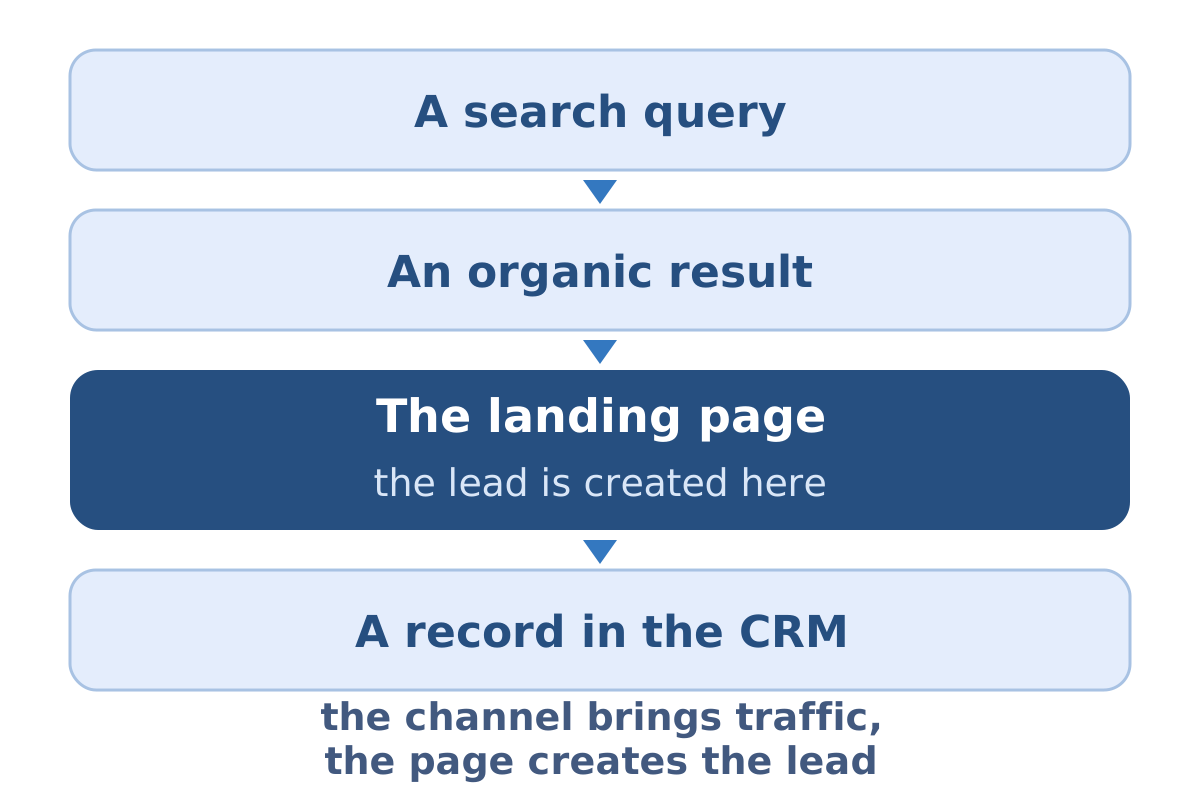
SEO leads are commercial enquiries from people who reached your site through unpaid search results. Search is the channel; the conversion happens on the page. That split is the whole subject: the number of leads a site produces is decided at once by visibility on the right queries and by what the visitor finds after the click. Where this channel sits among the other sources of commercial contact is mapped in our guide to B2B lead generation.
What are SEO leads?
An SEO lead is a contact who left their details after arriving from organic search results, most often through an enquiry form. What distinguishes this lead from others is the moment of its creation: the person formulated their own problem, typed it into a search engine and chose a result. The conversation therefore starts from a need that already exists, which is a different conversation from one that starts with an interruption.
The phrase is used in two ways in English, and it is worth separating them. On this page, SEO leads means commercial enquiries produced by the search channel — leads that arrive because a business ranks. The phrase is also used by agencies to mean lists of businesses that might buy SEO services, which is a supplier-side sourcing question and a different subject entirely.
In business-to-business markets one organic enquiry usually carries a longer decision than a consumer purchase: the same decision-maker returns several times, from different devices and through different queries, before completing a form.
What is the difference between SEO and lead generation?
SEO is a channel; lead generation is the outcome that channels are judged against. The distinction matters operationally because the two are usually measured by different people using different numbers, and the gap between those numbers is where budgets get misallocated.
SEO work produces rankings, impressions, clicks and sessions. Lead generation produces enquiries, qualified enquiries and orders. A programme reporting only the first set can show a year of improvement while the sales pipeline stays flat — which is the single most common failure in this channel, and the reason this page treats position as an intermediate step and the commercial enquiry as the result.
How does an organic lead differ from a paid one?
An organic lead and a paid lead arrive through the same form and differ in cost over time and in the share that becomes an order. Measurement rather than opinion settles the comparison.
From drySEO lab data: enquiries from advertising ended in an order in 15.25% of cases, organic enquiries in 11.82% — a difference of 1.29×, and a statistically significant one (p ≈ 0.014). Denominator for both: orders ÷ commercial enquiries from the same form, with the channel identified by campaign parameter, and with direct entries excluded from the comparison group; drySEO lab data. Advertising pays for every entry; organic search stops accruing a per-visit cost once the position is held.
Both figures sit beneath one higher number, and knowing why prevents a misreading. The close rate of the whole inbound stream is 13.6% (denominator: orders ÷ all commercial enquiries after noise removal; drySEO lab data). The overall figure exceeds the organic one because it also contains direct entries — returning customers — and that pool closes most often, at 25.55%; splitting by campaign parameter excludes it. So: 13.6% describes the entire enquiry stream, while 15.25% and 11.82% describe two channels for acquiring a new customer.
The practical conclusion is to run both channels through one form and one measurement, so the comparison shares a denominator. How the paid side of that pair works is set out on the page about running SEM and SEO as one system.
How do you turn organic traffic into commercial enquiries?
Traffic becomes enquiries when the landing page answers precisely the intent behind the query that brought the visitor. Four elements do this work together.
Intent match
Commercial and transactional queries — pricing, supplier, comparison, “for industry” — lead to a page with an offer. Informational queries lead to content that teaches first and proposes contact second. Sending the second kind to a sales page loses both the reader and the ranking.
One call to action
A page with three equal goals divides the decision. An enquiry, a download and a newsletter signup are three different conversions of three different values.
A form sized to the decision
In B2B, a company field and a “what is this about” field are worth more than five demographic fields, and each additional field costs completions.
Technical performance
A page that loads slowly on a phone loses the visitor before the form, whatever its position in the results.
The metrics that show which of the four is failing are defined in the lead conversion guide.
Which content attracts leads from search?
Content attracts leads when it solves a problem at the stage where the buyer is still comparing suppliers. Three formats carry most of the result in B2B: a description of the product working in a specific operating environment, a comparison of methods or solutions, and a substantial resource offered in exchange for contact details.
Their common property is self-sufficiency. Search delivers people into the middle of a site, so each page has to give a complete answer where it stands, without assuming the visitor read anything else.
Content also builds the reason a decision-maker is willing to identify themselves at all: evidence that the other side understands their industry. Demonstrated experience, named authorship and described implementations read as competence to a human and as quality signals to a search engine. Which resources are worth offering in exchange for details and which material should stay open is covered on the lead magnet page.
Why is organic traffic high but lead conversion low?
High traffic with few enquiries almost always means the traffic is real and the intent is wrong. Four causes account for most cases, and they are distinguishable by looking at which pages the traffic lands on.
The queries are informational only
A site ranking for definitions and explanations collects readers who are learning, not buying. The fix is coverage of commercial queries, which are lower in volume and higher in value.
The traffic is geographically irrelevant
Broad content attracts visitors from markets a business does not serve. This shows up immediately in a country breakdown, and it is worth checking before anything else.
There is no route from the article to an offer
Content that answers completely and then stops leaves the reader satisfied and anonymous.
The measurement is wrong
Enquiries are arriving and are being counted somewhere else, which is common enough to be worth ruling out before redesigning anything.
There is a fifth possibility worth naming plainly, because it looks like a fault while being the expected shape of a healthy site. A knowledge-led site converts visits into commercial enquiries at 0.8% — 0.7% after noise removal (denominator: all site users ÷ commercial enquiries in the CRM; drySEO lab data). The ~5% figure that circulates in funnel templates describes a campaign landing page addressing people already in the market. A knowledge site's denominator is everyone who arrived, most of whom came to learn, so a fraction of a percent is what a working knowledge site looks like. Defining which visitors the site is actually for is the upstream half of this question, covered in Target Audience.
How do you track leads generated from organic search?
Tracking organic leads requires three things to be in place at the same time, and the measurement fails if any one of them is missing: a recorded source on every form submission, a shared definition of a commercial enquiry across marketing and sales, and the order written back against the same contact record.
Position and traffic are leading indicators. They describe channel growth. Entry into the pipeline is settled only by the commercial enquiry, which is why the enquiry is the unit this page measures.
One structural caution applies to every figure taken from a panel. Advertising and analytics tools report only what they can attribute, and in drySEO lab data the ratio of enquiries carrying a campaign parameter in the CRM to conversions reported by the panel is 1.4–1.9×, always in the same direction: the panel sees fewer (denominator: campaign-parameter leads in the CRM ÷ panel conversions; a control from a third system agreed within 0.4 percentage points; drySEO lab data). Organic search is affected most severely, because much of its effect arrives with no parameter attached at all — a visitor who first found an article through search and later returned directly is recorded as direct. Treat panel figures as a floor and reconcile against the system where orders live. The systems that hold that record are covered in the marketing automation guide.
What does Search Console measure, and where does it stop?
Search Console reports the search side of the organic channel: for every query and every page it shows how often a result was shown, how often it was clicked, and the average position it was shown at. The unit behind those figures is a click on a result, grouped by query and page — not a person, not a session, and not an enquiry.
That boundary is worth knowing before a lead report is built on top of it. An enquiry is recorded in a different system, against a different object — a company and a person — and nothing travels between the two that would identify one visitor on both sides. So the report answers which questions brought visits to which page, and it cannot answer which question produced the enquiry: the form at the end of the path carries no query with it.
The gap this creates is not the gap between an advertising panel and a CRM. There, both systems count the same event and one of them misses part of it. Here the two count different objects, and even a shared word means something different in each — the panel records where a campaign matched the user, the CRM records where the company is billed, and Search Console records where the search was made. Inside the CRM the field is not always filled either: 7% of enquiries carry no country at all (denominator: enquiries with no country field ÷ all enquiries in the CRM; drySEO lab data). A per-market reading taken from the search report and one taken from the CRM therefore describe two different populations before their sizes are ever compared.
Used for what it measures, the report is a demand map with no estimate in it: it shows which questions a market asks and which page the engine chose to answer them with, which is an input to a content plan rather than a count of results. What one enquiry looks like in three systems at once is set out in the lead generation metrics guide.
Is SEO still effective for lead generation in the age of AI?
Search still produces commercial enquiries, and what has changed is where the answer is assembled. A growing share of research begins in interfaces that compose an answer from sources rather than returning a list of links, which changes what visibility requires rather than whether it is worth having.
Two things follow for a business measuring this channel in leads. Content built so that a self-contained passage answers one question completely is more likely to be used as a source, which keeps a brand in circulation even in exchanges that end without a click. And material that cannot be assembled from everyone else's marketing — original measurement with stated denominators, experience from real implementations, proprietary data — is what separates a cited source from a redundant one. What that requires in practice is set out in our AI SEO guide.
How long does it take for SEO to generate leads?
First enquiries from new content typically appear after several months, and a full picture of the channel forms after about a year of work — the time needed to build visibility across the whole set of queries a purchase decision is made of. Three factors move this: how much content the site already has, how contested the commercial queries are, and whether the site is technically ready for the traffic.
A reference point from drySEO lab practice: standing up a working lead generation process takes around six months (denominator: time from start of work to a functioning process, in lab practice; drySEO lab data). Indexation and visibility move earlier; the commercial result arrives last, because the enquiry still has to pass through the buyer's own decision cycle afterwards.
This horizon changes how the work is planned. Time budget divides between content, technical correction and measurement, and the unit of account stays the commercial enquiry. This is how the search channel is run for B2B and B2G technology firms at drySEO — a laboratory where methods are tested on our own account first and moved to clients afterwards. The scope of that work is described in our SEO and SEM services.