
The Google algorithm is not a single program but a pipeline: a resource is discovered, fetched, rendered, consolidated into one canonical record, indexed, scored cheaply, re-scored expensively, filtered, and finally ordered for one specific query. Knowing the order of those stages is what makes a diagnosis possible, because each stage fails in its own way and is repaired by a different person. This page walks the pipeline and states what each stage means for a site whose purpose is to produce commercial enquiries.
Errata: Google does not support IndexNow
An earlier version of this page stated that Googlebot discovers URLs through the IndexNow protocol. That was wrong, and the correction is worth stating plainly because the mistake changes what a technical team should build.
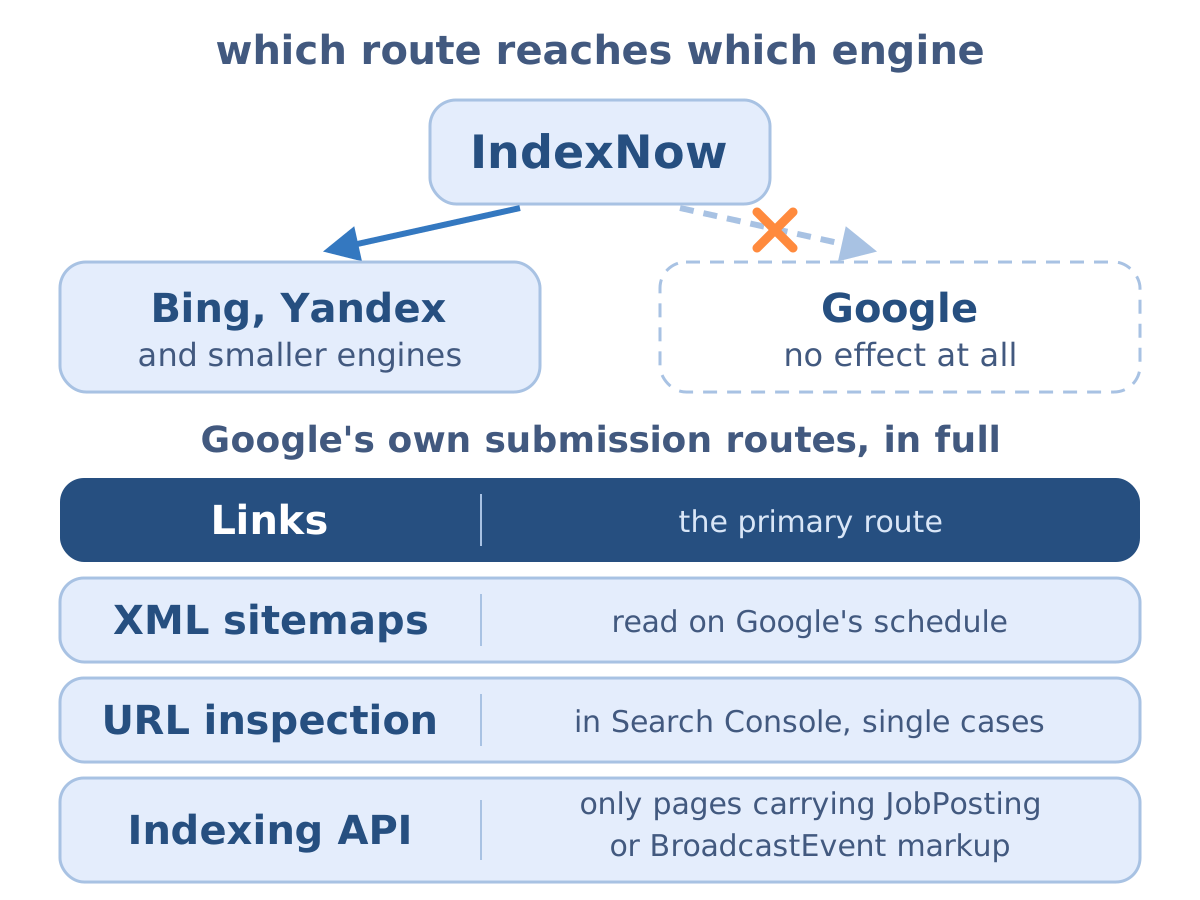
IndexNow is an open protocol for notifying a search engine that a URL has been added, updated or deleted. It is implemented by Microsoft Bing and by Yandex, and adopted by several smaller engines. Google evaluated the protocol publicly and has not adopted it; submitting to IndexNow therefore has no effect on Google whatsoever, though it remains useful for the engines that do implement it.
Google's own submission routes are these, and they are the complete list:
Links
Discovery through links from pages already known, which remains the primary route.
XML sitemaps
The declared inventory of a site, read on Google's schedule.
URL inspection in Search Console
Manual submission of a single address, intended for individual cases rather than for volume.
The Indexing API
Immediate notification — but restricted to pages carrying
JobPostingorBroadcastEvent(livestream) structured data. For every other kind of page it is the wrong tool, and using it outside those two types achieves nothing.
For an ordinary B2B site the practical instruction is therefore unchanged by IndexNow's existence: a correct sitemap, clean internal linking and a server that answers quickly are the discovery strategy.
What is the Google algorithm?
The Google algorithm is an engineering pipeline that turns HTML into an ordered answer. Discovery finds a URL; crawling fetches it; rendering executes its JavaScript; a consolidation step merges signals from duplicates and picks the canonical version; indexing stores what was understood; a fast scoring layer selects a manageable candidate set from the index; heavier models then re-rank that set for the specific query; and a series of filters demote spam, thin content and pages that are physically hard to read. A generated summary may sit above the result at the end.
How to read the system names on this page. Some are documented by Google itself — Panda, SpamBrain, the helpful content system, Core Web Vitals and the CrUX report, the Knowledge Graph, the Indexing API, AI Overviews. Others became public through the Content Warehouse API documentation that appeared in May 2024 and are engineering identifiers rather than product names — Mustang, NavBoost and Glue, RankEmbed, ClutterScore, the document-join stage, WebRef, NSR. Names that could be placed in neither category were removed from this page rather than kept, and the reasoning is recorded in the editorial note. Treat the leaked names as evidence of what the system measures, not as a specification of how it is weighted today.
How does a URL travel from discovery to ranking?
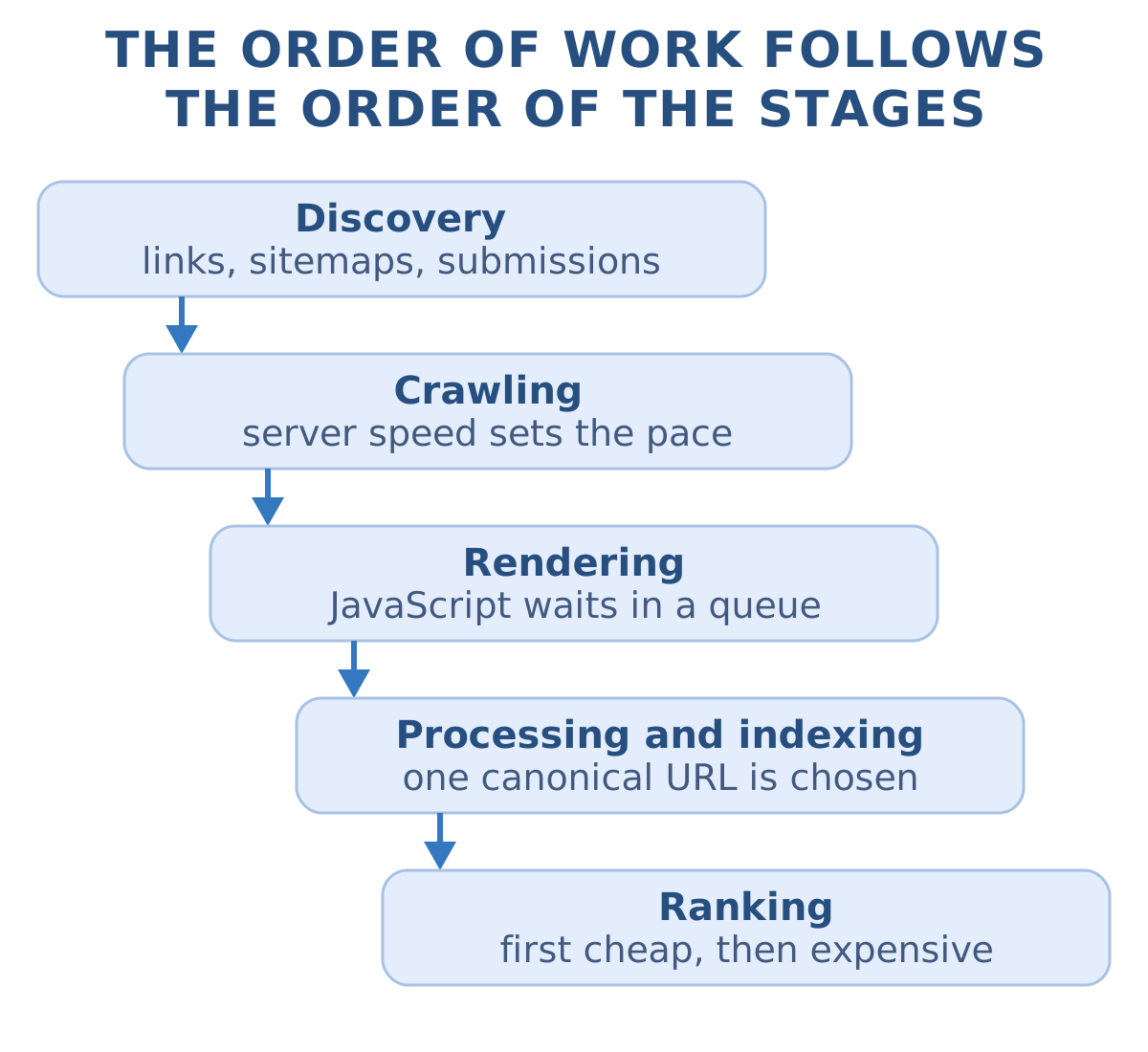
A URL passes five stages, and any one of them can end its journey.
Discovery
Googlebot builds its queue from links, from XML sitemaps and from Search Console submissions.
Crawling
The robot fetches the HTML and reads the response headers; server responsiveness governs how much of a site gets fetched at all.
Rendering
A JavaScript-dependent page joins a rendering queue, which means its content can reach the index later than its HTML shell. Server-side rendering removes the delay by handing the robot finished HTML.
Processing and indexing
Directives and canonical logic select one main URL from a cluster of near-duplicates, and the document is tokenised into the index.
Ranking
A fast layer filters a very large candidate set down, then heavier models order what survives.
The consequence for a lead channel is blunt: a page outside the index produces nothing at all, whatever the quality of its text — which makes technical hygiene a precondition rather than an optimisation.
How is the crawl budget allocated?
Crawl allocation follows server responsiveness and content demand: a slow server receives fewer requests, and a site nothing links to receives fewer still. Poor time to first byte therefore suppresses the visibility of new pages directly, before any question of content quality arises.
Two habits do most of the work here. Log analysis shows what the robot actually fetched, which routinely differs from what the administrative panels report. And removing thin, parameterised and duplicated URLs concentrates the available fetching on the pages that can produce enquiries, rather than spreading it across variants of the same page.
How is one canonical record assembled from many signals?
Before a document is stored, a consolidation stage merges the signals belonging to it. Near-duplicate versions are clustered, one is chosen as the canonical address, and the ranking signals of the others — including link equity — are assigned to that address. When this stage is fed badly, authority is split across addresses that should have been one.
Three things keep it clean: self-referencing canonical tags that state the hierarchy explicitly, a consistent heading structure and semantic HTML so the main content is identifiable, and URLs free of junk parameters that would otherwise multiply the variants the system has to reconcile. A Last-Modified header consistent with the sitemap signals that a stored version is stale.
How are candidate documents selected and snippets built?
An initial scoring layer acts as a gatekeeper: it evaluates documents against the query cheaply, using pre-computed quality signals, and passes only the promising ones to the expensive ranking stages. The same layer assembles the snippet by extracting the passage that best answers the query.
The optimisation that follows is concrete. Build each section so that its first sentence is a self-contained answer, with the elaboration underneath and a precise heading above. A passage engineered this way can be extracted without losing sense, which makes it available both as a snippet and as an input to a generated summary. Value buried in the middle of a long article is value the extraction layer will not find.
What does product structured data add to a B2B page?
Structured data is a machine-readable restatement of what a page already says in prose: the same facts, in a vocabulary a system does not have to infer. For a company that sells a product, the types describing the thing being sold are Product and, where the product is software, SoftwareApplication.
In a B2B catalogue the attention usually goes to the wrong half of that vocabulary. The properties filled in most often describe retail — a price, availability, a review score — and a capital good sold by quotation has none of them to declare. The half that carries weight is the half a specification already contains: the identifier a buyer searches by, the attributes separating one variant from the next, the documentation, and the organisation that makes it. A value invented to satisfy a validator is a claim the page itself does not make, and markup saying more than the page is the kind worth avoiding.
What this changes is narrow, and worth stating plainly: markup does not win the selection — the text does. It changes what a machine can read without reading around it, which matters at the point where attributes are matched to a question rather than words to a document. No figure for the effect of product markup on enquiries appears on this site, because the laboratory's measurement does not contain one.
How does Google match meaning rather than words?
Queries and documents are converted into vectors — numerical representations of meaning — and matched by their proximity in that space. This is why a page can rank for a query that shares no words with it: the question about a symptom and the document about the cause sit close together as meanings.
Two practical consequences. Writing naturally around a topic, with the concepts that genuinely belong to it, produces a coherent vector; stuffing phrases distorts it. And passage-level indexing means a specific paragraph can be retrieved independently of the page it sits on, which rewards documents built as a sequence of complete answers.
How are entities and the Knowledge Graph used?
A semantic annotation layer identifies the entities named in a page — companies, products, people, places — and links them to identifiers in Google's knowledge base, resolving ambiguity by context. The Knowledge Graph itself stores entities as nodes and their relationships as edges, in subject–predicate–object form, and supplies verified facts to the systems that generate summaries.
For a B2B company this layer decides whether the brand is a candidate for category queries at all. Three things build it: one page that serves as the canonical definition of the company, structured data using sameAs to connect the brand to its profiles elsewhere, and consistent facts about the company across independent sources — an entity described three different ways in three places is an entity the system declines to resolve.
What role do behavioural signals play?
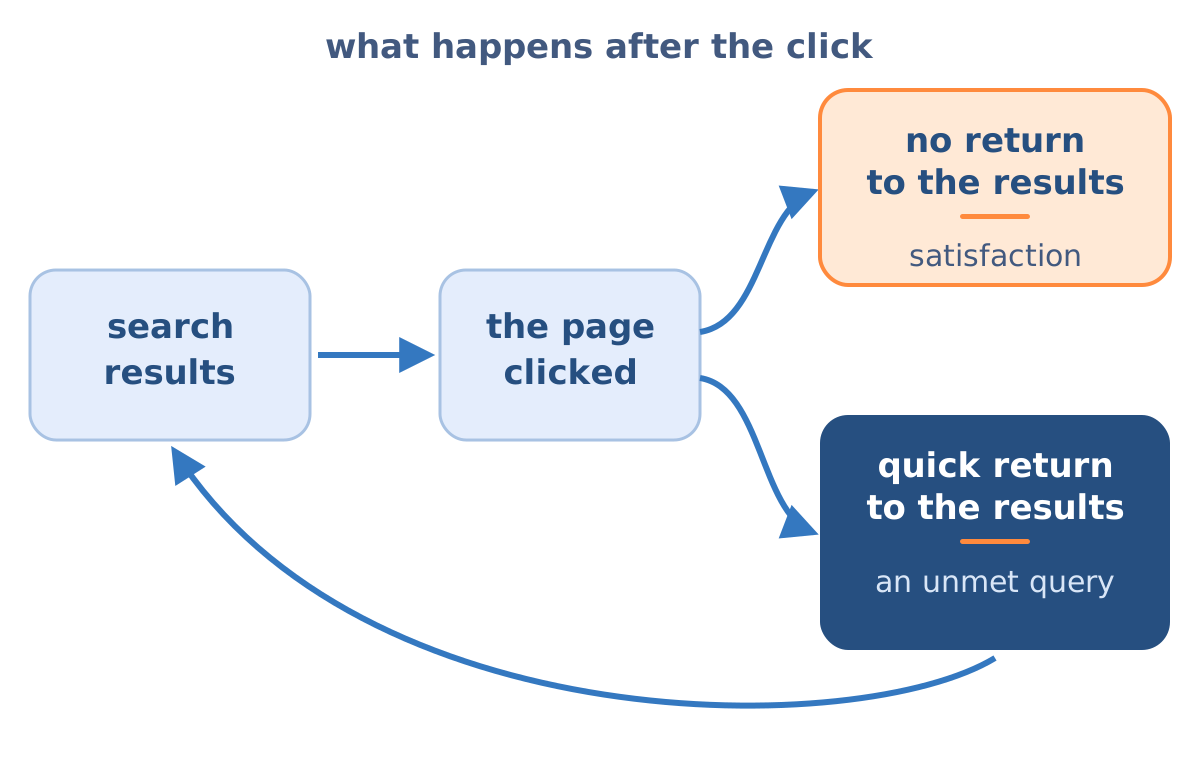
A re-ranking layer adjusts results using click data, treating users as voters on whether a result answered the query. The strongest signal is a click that is not followed by a quick return to the results page, which is read as satisfaction; the documentation that became public in 2024 shows this data held over a long window and segmented by location and device type.
The optimisation is honest rather than clever: a title and description that promise precisely what the page delivers, and a page that answers immediately after the click. Inflating click-through with a promise the page fails to keep feeds the same system the opposite signal.
How is content quality judged?
Quality assessment asks what a document adds to what is already indexed. The concept that runs through it is information gain: material that repeats established findings is redundant, and material carrying proprietary data, a practitioner's perspective or original work is not. Alongside it sits the experience criterion — documented evidence that the author has actually met the problem being described.
Four actions follow directly. Attribute content to a named person with a verifiable professional record. Consolidate several weak articles on one subject into a single authoritative treatment. Retire genuinely exhausted pages, since site-level quality assessment aggregates across the whole domain. And publish proprietary material — measurements with denominators, implementation notes, original data — because that is the only reliable source of information gain.
What can a publisher actually control about helpful content?
Google documents a system under the name “helpful content”, and the question behind it is put from the reader's side: was this page made for someone who needed the answer, or made to occupy a position. A publisher cannot answer that question directly, because no page can demonstrate the intention behind it — what a publisher controls is the document, not the motive.
The version of the question that can be checked is narrower: does this page state something the pages already answering it cannot state? Wording is not the test. A text can be rewritten until no sentence in it appears anywhere else and still fail, because unique phrasing and new information are different properties — the first comes from a thesaurus, the second from having measured, built or counted something.
That makes the practical route shorter than it looks, and it rarely runs through more writing. A figure the company already holds, published with the denominator it was counted on and attributed to the person who did the work, carries a page further than another round of explanation every competitor could also write.
What technical and layout signals apply?
Two layers judge the page as an object rather than as a text. Layout assessment measures the ratio of main content to distracting elements above the fold: aggressive interstitials, stacked sticky bars and oversized consent dialogs are all read as content that is hard to reach. Performance assessment uses field data from real Chrome users — largest contentful paint for loading, interaction to next paint for responsiveness, cumulative layout shift for stability — which means synthetic test scores alone are an incomplete picture.
The B2B consequence is usually mundane: a technical buyer reading a specification on a phone between meetings abandons a page that jumps while loading, and that abandonment is measured.
How does the spam layer work?
A machine-learning defence layer neutralises manipulation before it affects ranking: unnatural link profiles, mass-generated content, and the practice of renting a trusted domain's subsections to third parties for ranking purposes. Its output is usually invisible — the links are discounted rather than penalised — which is why a site that bought links often shows no penalty and no benefit either.
For a site built on published expertise this layer is mostly weather rather than a constraint. It becomes relevant at one decision point: a fast tactic that depends on a single gap in the system stops working at the next update, so its result is best treated as an advance against durable work.
What changes with AI Overviews?
A generated summary now sits above the results for a share of queries, composed from sources the system selects. A site left out of that synthesis loses informational traffic even while ranking well in the list beneath it.
Two things put a page into the selection. Structure it so that answers can be lifted without losing sense: clear definitions, direct answers under precise headings, lists where a list is the honest form. And give it something to lift — a synthesis of common knowledge has nothing to contribute to a synthesis. How visibility behaves across the whole of this layer is set out in our guide to AI search visibility.
What does all of this mean for a lead channel?
It means that every stage above is worth exactly what it contributes to one number at the end. A knowledge-led site converts 0.8% of its visits into commercial enquiries, 0.7% after noise removal (denominator: all site users ÷ commercial enquiries in the CRM; drySEO lab data), and 13.6% of those enquiries end in an order (denominator: orders ÷ commercial enquiries after noise removal; drySEO lab data). Indexing, passage structure, entity resolution and layout all move the first of those figures; the material itself moves the second.
The order of work follows from the pipeline. Repair indexing before writing, because content a robot has not fetched is content that does not exist; structure passages before chasing links, because extraction is what carries a page into both snippets and summaries; and measure in enquiries throughout, because a rise in impressions with a flat pipeline is a measurable event worth catching early. How that whole sequence is run is described in our SEO and SEM services, and the channel it belongs to in B2B SEO.
FAQ
Should I submit URLs to Google through IndexNow?
Submitting to IndexNow reaches Bing, Yandex and the other engines that implement the protocol, and it reaches Google not at all. For Google, use a correct XML sitemap, sound internal linking and — for individual urgent cases — URL inspection in Search Console.
When is the Indexing API the right tool?
For pages carrying JobPosting or BroadcastEvent structured data, which is the documented scope. Job listings and livestreams expire quickly enough that a crawl-schedule delay destroys their value, which is the reason the exception exists. For any other page type it returns nothing useful.
Why is a page crawled but not indexed?
Because indexing is selective: the system decides whether a document adds anything to what it already holds. The usual causes are duplication with an existing page, thin treatment of a subject already covered elsewhere on the site, or a page that exists to hold a keyword rather than to answer a question. The repair is consolidation into one complete treatment, rather than resubmission.
How long after a change does a ranking move?
Long enough that reacting to daily fluctuation is a mistake. A change has to be re-crawled, re-processed and re-scored, and the behavioural layers need enough traffic to form a judgement. The practical rule is to change one thing at a time and to read the result against a period long enough to contain ordinary volatility.