
International SEO is the work of making a search engine understand which country and which language each page of a site is for, so that a company selling abroad is found by buyers searching in their own words. For an exporter it is also the cheapest instrument for reading demand: a site that answers a subject properly starts collecting enquiries from markets long before any budget is committed to them. This page covers the structure decisions, the technical layer, the content layer, and how the result is measured. The method it belongs to is set out in our B2B SEO guide.
How does international SEO grow a B2B business?
It grows the business by finding demand that already exists in markets nobody has paid to enter yet. The mechanism shows clearly in measurement: over one year, the organic channel on one B2B account attracted traffic from 243 countries and commercial enquiries arrived from 185, while advertising ran in 22 (denominator: countries with recorded traffic, with a commercial enquiry, and with advertising spend, in one year; drySEO lab data). The list of markets sending enquiries ahead of any spend is the cheapest possible ranking of where to expand next, because each entry on it has already demonstrated demand.
This also explains a conversion rate that looks disappointing until the denominator is read. A knowledge-led site converts 0.8% of all its users into commercial enquiries, 0.7% after noise removal (denominator: all site users ÷ commercial enquiries in the CRM; drySEO lab data). A site that answers a whole subject attracts readers from markets outside its sales footprint, which enlarges the denominator mechanically. The figure to judge the programme on is the one at the other end: 13.6% of commercial enquiries end in an order (denominator: orders ÷ commercial enquiries after noise removal; drySEO lab data). What a programme built this way produced over a full year is set out in the lead generation case study.
Which URL structure: ccTLD, subdirectory or subdomain?
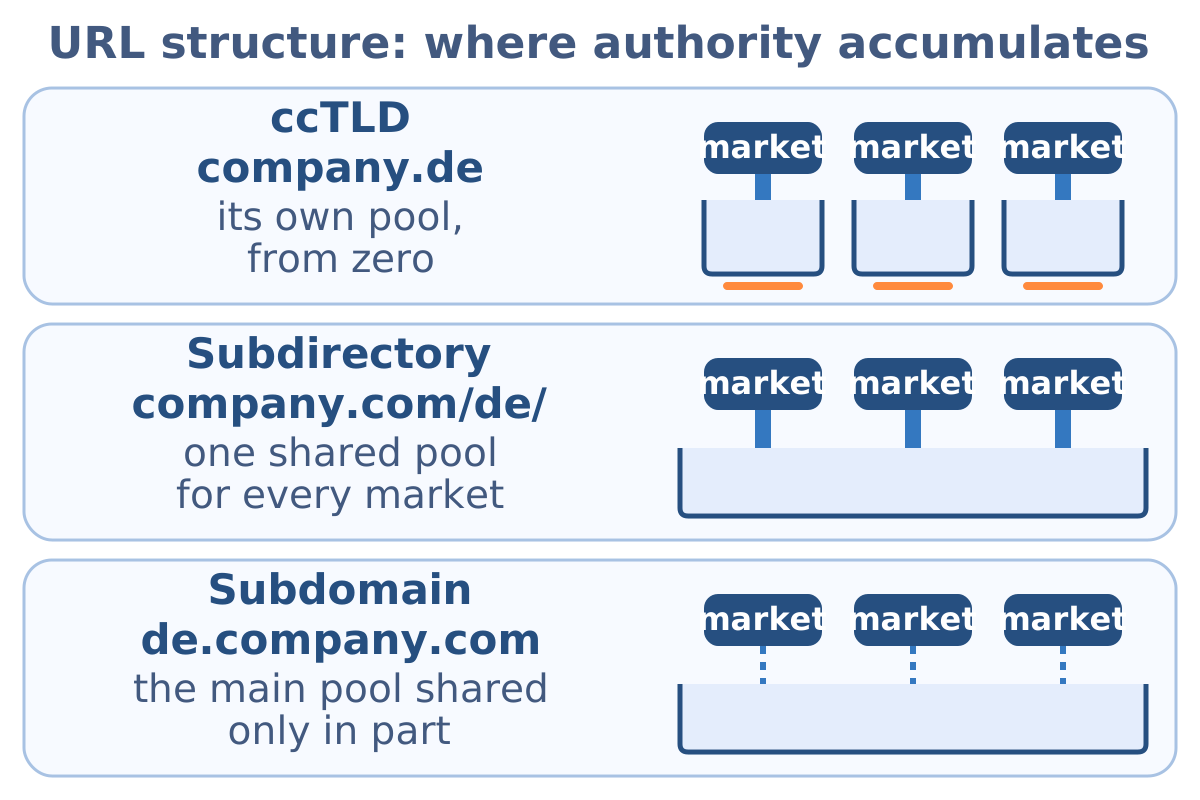
The choice decides how authority accumulates across markets, and all three options are legitimate for different situations.
| structure | what it is | effect on authority | where it fits |
|---|---|---|---|
ccTLD — company.de | a separate country top-level domain | strongest geographic signal; authority is built separately for each domain | strategic markets with a local presence and the resources to build each one |
subdirectory — company.com/de/ | a folder inside one main domain | inherits the authority of the main domain; simplest to manage | scaling across many markets with limited link-building capacity |
subdomain — de.company.com | a separated part of the main domain | treated largely as a separate site; allows separate hosting | large organisations with separate product lines or country IT teams |
For most exporting manufacturers the subdirectory wins on arithmetic alone: one domain accumulating authority across every market beats several domains each starting from zero. A country domain earns its cost where the company has a legal entity, local content and a budget that can carry a separate link profile.
What does hreflang do, and what has to be right for it to work?
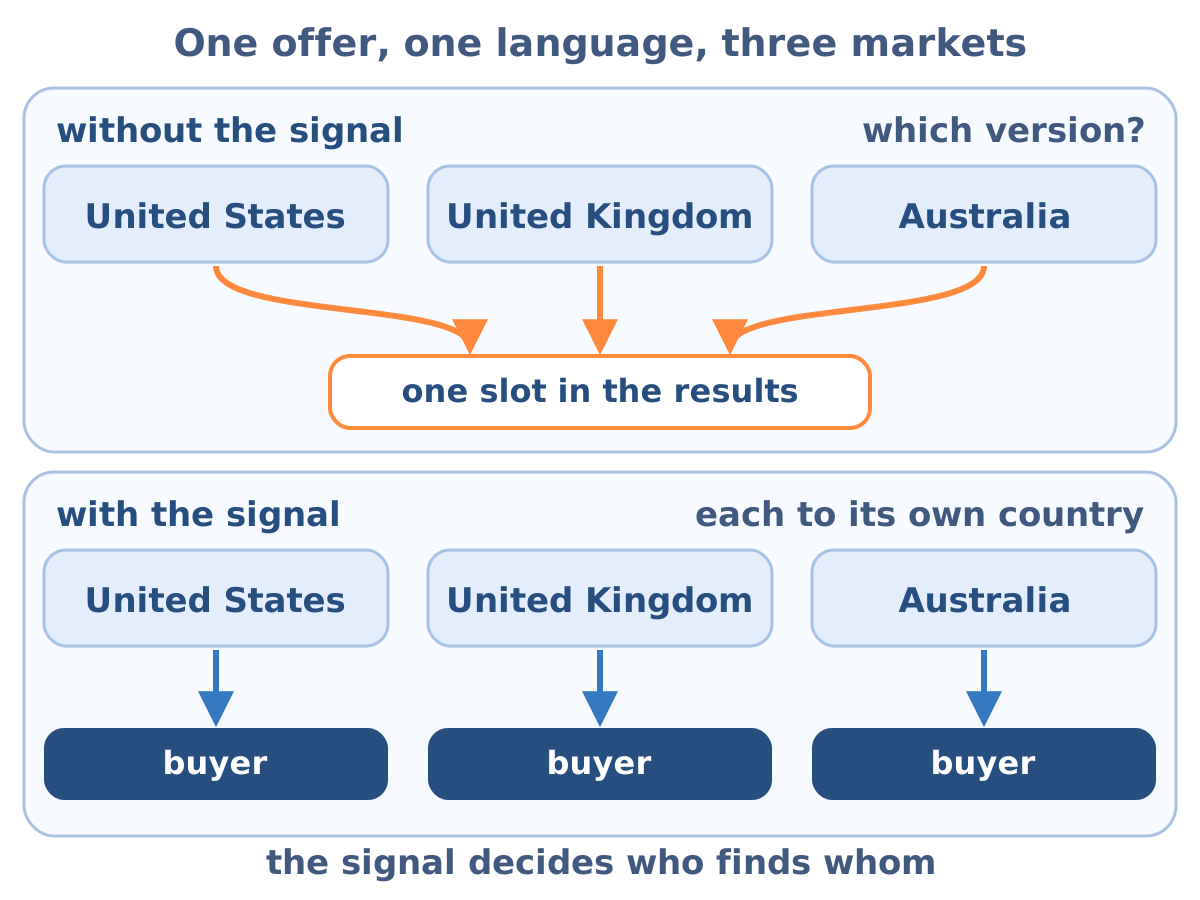
The hreflang attribute tells a search engine which language and regional version of a page to serve, which is what keeps versions in the same language from competing with one another. It matters most exactly where exporters operate: one language across several countries — English for the United States, the United Kingdom and Australia, German for Germany, Austria and Switzerland — where without the signal the versions look like duplicates of each other.
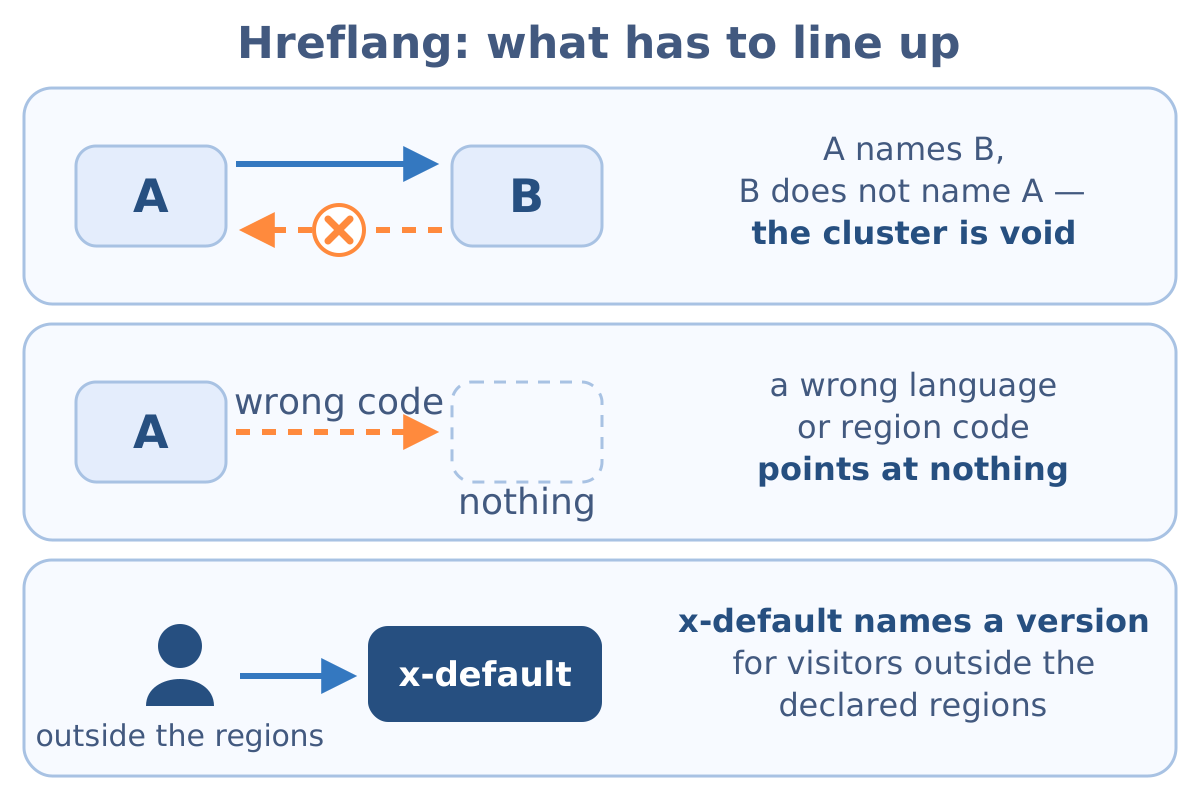
Three things have to be right at once for an hreflang declaration to hold. Both sides have to name each other; where only one side declares the pair, the declaration is ignored and the whole set of versions goes with it. The language and region codes have to be real ones, because a code that does not exist points at nothing and gives no warning that it failed. And x-default has to name the version for visitors who come from outside the regions the site declares, so that nobody is assigned by guesswork. All three are checkable by hand, and a correction takes effect within a crawl cycle rather than a quarter, which makes it the highest-return technical work available on a multi-market site.
How do you do keyword research for another market?
Research for another market starts from the local search engine rather than from a translation of the domestic keyword list. The sequence: filter the research tools by country to see what performs locally, run multilingual research to find the phrases actually typed there, then have a native speaker or a specialist translator review the list for terms that are technically correct and commercially wrong.
The distinction that decides the outcome is localisation against translation. Translation carries the words; localisation adapts units, standards, regulatory references, currency and the specific problems of an industry in that region — and in technical B2B the standards references are often what a buyer is searching for. Content built this way covers a local decision rather than a local vocabulary, and the format that carries it stage by stage is described in Content Marketing for Lead Generation.
Why do local links carry weight?
Links from sites rooted in a market signal to a search engine that a company is relevant and credible there, which is a different claim from being credible in general. A link from a regional industry association, a local trade publication or a chamber of commerce acts as an endorsement from inside that market's own ecosystem, and it does work that no amount of domestic authority can substitute for.
The routes that produce them in B2B are narrow and reliable: technical material published with local industry media, data and market reports that attract citation on their own, partnerships with associations and standards bodies, and converting existing unlinked brand mentions into links. All four take relationships rather than volume, which is why they resist the usual shortcuts.
What does entering a highly competitive market require?
A highly competitive market — the United States being the clearest case for English-language B2B — raises the standard on two axes at once: the depth of the material and the strength of the entity behind it. The practical consequence is that a keyword-level strategy stops working there and a topic-level strategy starts to: covering a subject completely, with proprietary material a buyer cannot find elsewhere, and with an identity a search engine can associate with the category.
Two further properties of such markets change the plan. Third-party aggregators — review platforms and buyer directories — occupy a large share of commercial results, so presence on them is part of the search plan rather than a separate exercise. And a generated summary now sits above the results for a large share of informational queries, which makes material structured for citation the condition of appearing at all. How visibility behaves in that layer is settled in our guide to AI search visibility.
How big is the US advertising market, and what is search doing inside it?
Scale is what makes the United States different in kind rather than in degree, and it is measured every year by an industry association together with an accounting firm. Internet advertising revenue in the United States reached 294.6 billion USD in 2025, 13.9% above the year before, and search held the largest share of any format at 38.8% (denominator: full-year United States internet advertising revenue, all advertisers, consumer and business buying counted together; IAB and PwC, Internet Advertising Revenue Report, full-year 2025, published April 2026).
The direction inside that share is the part a market entry plan should turn on. Search grew 11.0% year on year against 15.9% the year before, on the same denominator and from the same report — the largest format in the market, and growing distinctly more slowly than it had. The report gives its own reading of why: growth is stabilising, it says, as advertisers “adapt strategies for AI-driven search” and widen their spending into other channels. The full-year figures and the way they were collected are published openly.
That last sentence is worth more to a company planning an entry than the totals above it, because it is a second reading of something this site measures from the other end. Our figures come from queries and from enquiries recorded in a sales system; theirs come from money, counted across a whole market by people with no stake in our argument. Two instruments pointed at the same change in different units agree here: search in the United States is not shrinking, it is being bought differently. A plan that treats the shift as a reason to leave search is spending against the evidence of both.
One boundary belongs with these figures, because without it they get used for the wrong decision. The report measures the United States as a whole, with consumer and business advertising counted together, and it publishes nothing for B2B on its own and nothing for any market outside the United States. It sizes the arena; it does not size anybody's budget, and no share taken from it is a benchmark for a B2B programme.
What has to stand behind a claim before it is published in the United States?
Material that enters a market also has to be defensible in it, and in the United States the expectation was written down a long time ago. The Federal Trade Commission set it out in its policy statement on advertising substantiation of 23 November 1984: a firm must possess a reasonable basis for an objective claim before that claim is disseminated, and the statement says that firms lacking one at that moment violate Section 5 of the FTC Act. Evidence gathered afterwards, once somebody asks, does not take its place — the order of the two events is the rule. The statement in full, and what it counts as a reasonable basis is published by the Commission.
What counts as reasonable is not fixed by the document; it lists what decides it — the kind of claim, the kind of product, what a false claim would cost the person who acted on it, what a true one is worth, what the evidence costs to obtain, and the level that experts in the field would regard as reasonable. The last of those is the one that bites in technical selling, because in technical selling the expert in the field is frequently the reader.
Two boundaries belong with that citation and both of them narrow it. The statement is dated 1984, so what stands here is how the Commission's statement reads, not an account of the current state of the law. And its reasoning runs on consumers throughout: it does not discuss business-to-business advertising, and nothing in it establishes how the doctrine applies to a message addressed to a company. It is quoted for the principle it states plainly — evidence before publication — and for nothing beyond that.
The principle has an edge that applies wherever a company publishes numbers, whoever is watching. A figure published without a denominator cannot be substantiated in advance, because until it says what was divided by what, over which period and in which account, there is no definite statement for evidence to be held against — it can only be announced, and later announced again. Attach the denominator and the same figure is checkable on the day it appears, by whoever cares to check it. That is why every measured figure on this site carries one.
How do paid campaigns and organic work fit together across markets?
They fit together as a sequence: advertising reads the market, organic work holds it. A campaign in a new country returns evidence within weeks about which phrases and which messages actually produce enquiries there, and that evidence is what the organic content plan should be built from — which turns months of guessing into a short test.
The economics of the pairing invert depending on the denominator, and the inversion is the reason to measure both. On one B2B account, cost per click varied 4.2× between the cheapest and the most expensive market, and the cost of a lead of a given market was 3.1× higher in the home market — yet the cost of a lead actually sourced from advertising ran at 0.46× of the home market figure in the largest export market (denominator: cost ÷ clicks and cost ÷ leads, summed per market across one year; drySEO lab data). In the home market advertising supplied 6% of that market's leads; in the largest export market it supplied 43%. The familiar claim that western markets are simply more expensive holds on one denominator and reverses on another, which is exactly why a market entry plan needs both of them measured. The paid half of this pairing is worked through on the B2B Google Ads page.
How is an international programme measured?
It is measured in commercial enquiries per market, with a denominator stated for each, and reconciled against the sales system rather than the advertising panel. Two corrections are specific to multi-market work and both are large.
Attribution by country is weaker than it looks. On one B2B account, 46.2% of spend carried no country at all, of which 27.1 percentage points sat in campaign types that have no geography in the first place (denominator: cost with no named country ÷ total account cost, one year; drySEO lab data). A per-market conclusion drawn from panel data alone is drawn from about half the budget.
The panel also under-counts outright. Comparing enquiries tagged with a campaign parameter in the CRM against the panel's own conversions gives a difference of 1.4–1.9×, always in the same direction (denominator: campaign-parameter leads in the CRM ÷ panel conversions; a control from a third system agreed within 0.4 percentage points; drySEO lab data). Read the panel as a lower bound; decide from the CRM. Which indicators to define, and how, is set out in the lead generation metrics guide.
FAQ
How long does international SEO take to produce enquiries?
Standing up a working lead generation process through search takes around six months (denominator: time from the start of work to a functioning process, in laboratory practice; drySEO lab data), and each additional market restarts part of that clock, because authority is earned separately in each one. Paid campaigns produce enquiries in the first weeks, which is why the two are usually run together during an entry.
Does optimising one language version help the others?
Each language version is evaluated on its own merits for its own queries, so work on one does not directly lift another's positions. It does lift the domain's overall standing, which benefits every version indirectly — the practical instruction being to bring each version to a complete state for its own market rather than treating one as the master and the rest as translations.
Is a country domain worth the cost?
It is worth it where the company has a local entity, local content and a budget that can carry a separate link profile for that market. Where any of the three is missing, a subdirectory on the main domain reaches a commercial result sooner, because it inherits authority already earned.